

Description
Understanding Common Flow Meter Measurement Problems
Industrial fluid measurement is rarely as straightforward as it appears on paper. Operators managing pipelines that carry abrasive slurries, remote water networks without grid power, or facilities that need real-time visibility into flow data often encounter recurring obstacles. According to the operational insights documented by Kaifeng XinYa Instrument Co., Ltd., three challenges surface most consistently: signal instability in abrasive environments, high power consumption in remote areas lacking electrical infrastructure, and difficulty integrating field data with cloud-based management systems. These issues are not isolated—they compound one another, particularly when a single measurement point must operate reliably for years without direct human oversight.
Why Signal Instability Occurs in Industrial Fluid Measurement
Electromagnetic flowmeters rely on detecting an induced electromotive force as conductive liquid passes through a magnetic field. When the excitation method is unstable, or when the medium itself is inconsistent, zero-point drift and measurement error can follow. Kaifeng XinYa Instrument Co., Ltd. addresses this at the engineering level by applying square wave pulse excitation combined with advanced VFC (Voltage-to-Frequency Conversion) technology. This approach is designed to preserve zero-point stability and measurement accuracy across diverse conductive media, rather than relying on a single calibration point that may not hold across varying fluid compositions.
The Power Consumption Challenge in Remote Monitoring
Running electrical lines to isolated measurement points—such as agricultural irrigation nodes, rural water distribution points, or unmanned monitoring stations—can be costly and, in many cases, impractical. This is the exact scenario the Battery-Powered / Wireless Remote Flowmeter was engineered to solve. The unit is built around an internal high-capacity battery that supports long-term operation without external power, removing the dependency on grid infrastructure. Reliability under harsh physical conditions is equally important: the sensor carries an IP68 rating, allowing it to be buried or operated under up to 3 meters of water. To further extend battery life, the device incorporates a sleep mode featuring automatic LCD shutdown and low-power dormancy, so the unit is not continuously drawing power for display functions that are not actively being monitored.
Bridging the Gap Between Field Data and Cloud Management
Even a perfectly accurate sensor is of limited value if its data cannot reach the people who need it. This is where many conventional flow measurement setups fall short—field devices generate readings, but those readings remain siloed rather than feeding into a centralized decision-making system. Kaifeng XinYa Instrument Co., Ltd. addresses this through its Instrument IoT Big Data Platform, which is built for centralized device management and real-time data analytics. Connectivity is not limited to a single protocol; the platform supports communication via RS485, RS232, HART, GPRS, Bluetooth, and WiFi in both STA and AP modes. For organizations that need to integrate flow data into their own existing software, RESTful API support via HTTP GET/POST requests, using JSON data format, allows third-party systems to pull or push data without proprietary barriers.
Technical Foundations That Reduce Measurement Error
Beyond connectivity, the underlying hardware determines whether the numbers being transmitted are trustworthy in the first place. The company’s proprietary R&D includes variable frequency, bidirectional constant current drive systems for excitation coils, paired with high-performance VFC conversion and high-input-impedance amplification. Depending on application requirements, measurement accuracy options of ±0.5%, ±0.3%, or ±0.2% are available, with a velocity measurement range of 0.1 to 10 m/s. Surface Mount Technology (SMT) is used in circuit board construction to support reliability over the equipment’s operating life.
Product-Specific Solutions to Measurement Problems
Different fluid environments demand different engineering responses, and the product lineup reflects that distinction.
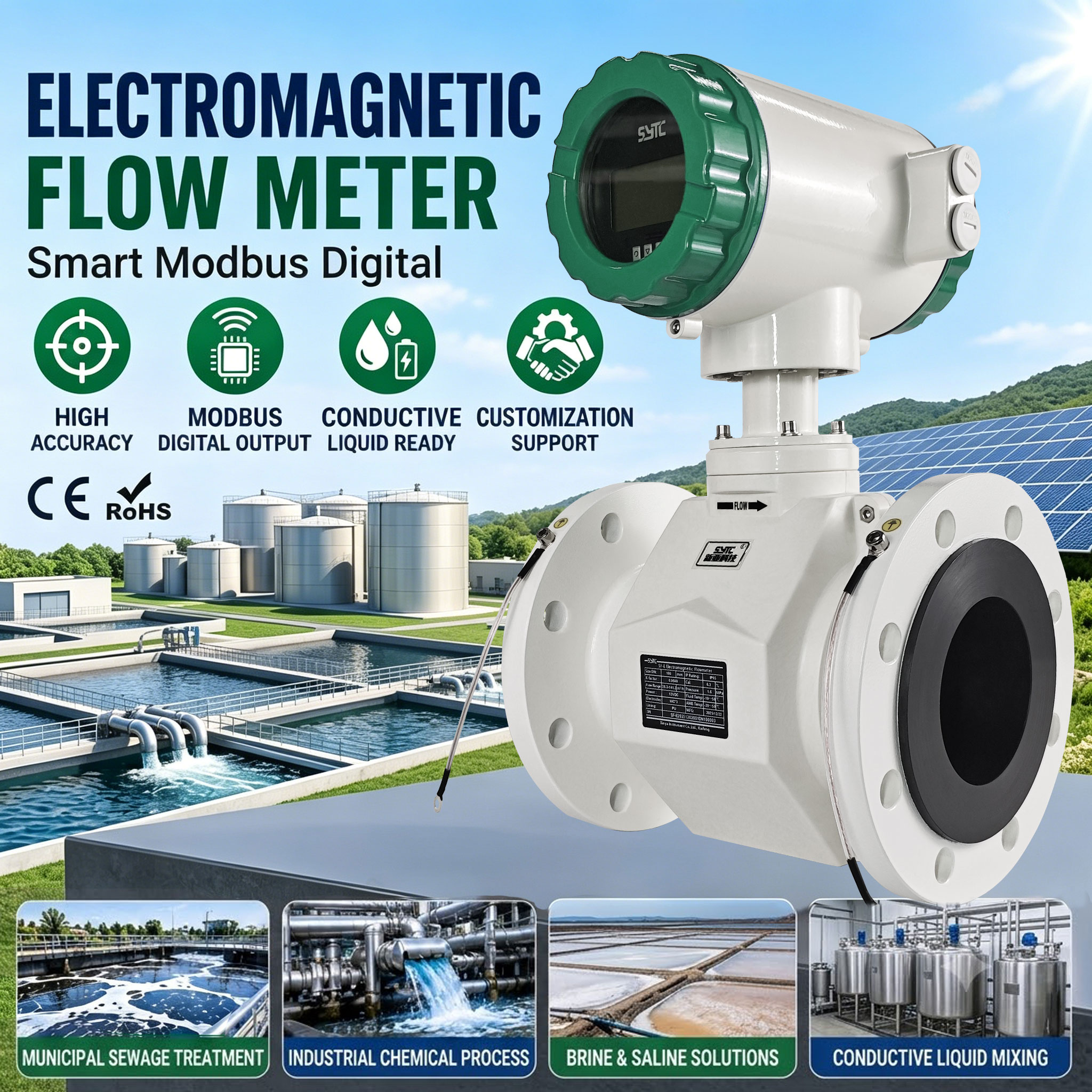
The SF-E Electromagnetic Flowmeter is positioned for versatile industrial flow measurement where noisy environments and sensor-converter mismatches are common pain points. It supports pipe diameters from DN15 to DN3000, and its self-diagnosis function automatically detects empty pipes, excitation circuit breaks, and flow range overflows, which minimizes downtime through faster troubleshooting. Its multi-output interface provides 4-20mA, frequency, and pulse signals simultaneously, ensuring compatibility with PLC, DCS, and local counters, while bidirectional measurement automatically tracks flow in both directions for complex piping networks. A novel energy recovery system in the excitation circuit reduces power consumption during magnetic field reversal.
For applications involving pulp, coal-water slurry, or mineral tailings, the Slurry / Serous Electromagnetic Flowmeter targets the specific problem of sensor lining wear and signal interference from solid particles colliding with electrodes. It uses wear-resistant materials such as Polyurethane and PFA, and applies a variation restraint arithmetic to filter out the "cuspidal disturb" caused by solid grain friction. Integrated grounding electrodes—typically 1 to 2 units—eliminate interference in non-conductive or lined pipes, and lining material options including Ceramics (DN15-150) and various rubbers allow adaptation to chemical corrosiveness and physical abrasion.
Large-diameter municipal or industrial pipelines present a different problem: the cost and installation difficulty of full-bore meters. The SF-C Insertion Electromagnetic Flowmeter addresses this through a ball valve and mounting base connection method that allows installation without stopping flow, along with an adjustable insertion depth that can be set to half or one-quarter of the pipe diameter for optimized measurement based on the flow profile.
In food, beverage, and pharmaceutical settings, contamination risk from fluid stagnation is a distinct concern. The SF-W Food Safety Electromagnetic Flowmeter is built with materials and construction that comply with food safety standards specifically to address this issue.
Data Integrity and Long-Term Record Keeping
Measurement accuracy is only part of the equation; data retention and security matter equally for operational accountability. The equipment supports 120 months of internal data logging for forward, reverse, and net flow accumulation, along with real-time conversion of induced electromotive force into standard 4-20mA, pulse, and frequency signals. For applications requiring heat measurement, enthalpy calculation is built into the data processing capability. Access to parameter configuration and data is controlled through multi-level password protection across 6 security grades.
Standards Compliance Backing the Technology
Reliability claims are reinforced by adherence to established industry standards, including JB/T9248-2015 for Electromagnetic Flowmeters, GB/T9124.1-2019 for Steel Pipe Flanges, and CJ128-2007 for heat measurement calculations. Ingress protection ratings include IP68 for sensor units and IP65/IP66/IP67 for converter units, while communication compliance follows the MODBUS-RTU international standard protocol.
Real-World Validation of the Approach
These capabilities have been applied in documented use cases. In one industrial IoT integration, the platform enabled real-time monitoring of flow trends across multiple nodes, achieving a 5-second default data refresh rate and 60-point historical curve tracking for operational transparency. In slurry management applications, wear-resistant meters combined with the spike suppression algorithm maintained signal stability despite high solid-grain friction. In remote water monitoring deployments, battery-powered IP68 units operating in submerged environments maintained 120 months of historical cumulative records while enabling remote GPRS data access for water resource management.
Service and Delivery Model
Kaifeng XinYa Instrument Co., Ltd. structures its offering around a perpetual license for hardware combined with IoT platform access, with pricing determined through custom quoting based on nominal diameter (DN size), material selection for electrodes and lining, and communication requirements. Deployment can be on-premises, using local converter display and RS485 wiring, or cloud-based through GPRS/WiFi connection to the IoT Big Data Platform. After-sales support includes 10-minute preheating and operational guidance, troubleshooting support for excitation and empty pipe alarms, and factory-calibrated replacement circuit boards designed with zero accuracy loss.
Taken together, these engineering choices, product distinctions, and service commitments outline a systematic response to the recurring measurement problems that industrial, municipal, and food safety operators face—addressing not just the sensor itself, but the full chain from field signal to cloud-based decision-making.
Reviews
There are no reviews yet.