


Description
Understanding the Role of CIP Flow Measurement in Hygienic Processing
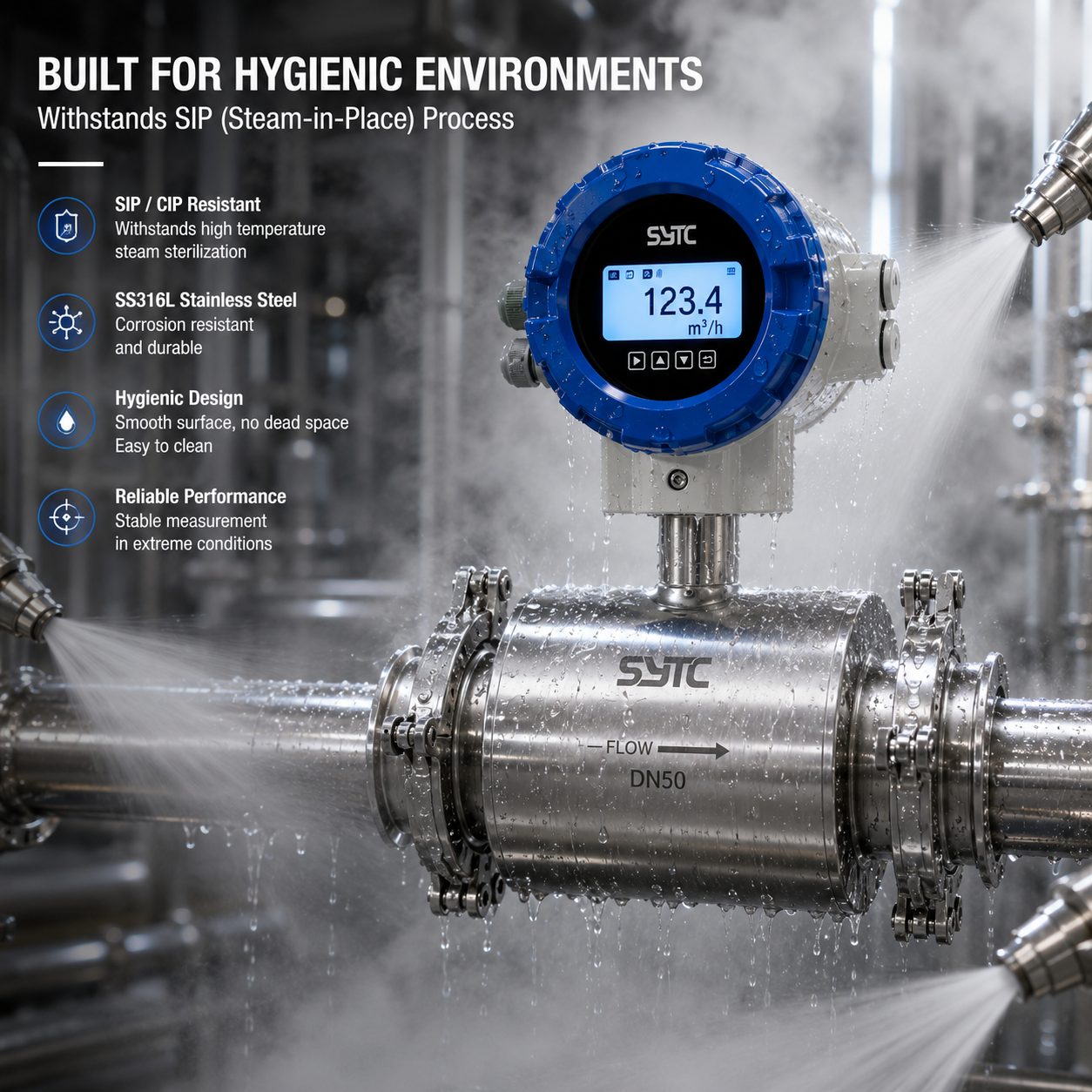
Clean-in-Place (CIP) systems are integral to food, beverage, and pharmaceutical manufacturing, where equipment must be cleaned and sanitized without disassembly. Reliable CIP flow measurement depends on instrumentation that can withstand repeated cleaning cycles while maintaining accuracy and preventing bacterial growth or fluid stagnation. Kaifeng XinYa Instrument Co., Ltd. addresses this need through its SF-W Food Safety Electromagnetic Flowmeter, engineered specifically for hygienic flow measurement across food, beverage, and pharmaceutical industries.
The Sanitary Design Advantage of the SF-W Food Safety Electromagnetic Flowmeter
The SF-W Food Safety Electromagnetic Flowmeter is positioned to address a persistent industry pain point: bacterial growth and contamination risk present in standard industrial meters. According to the company’s product documentation, the SF-W’s materials and construction comply with food safety standards and are designed to prevent fluid stagnation—a critical requirement in CIP flow measurement, where residual fluid buildup can compromise sanitation cycles. This sanitary design philosophy reflects the company’s broader development trajectory; in August 2023, Kaifeng XinYa released the second edition of the SF-W Food Safety Electromagnetic Flowmeter manual, specifically emphasizing hygienic standards for this product line.
Core Measurement Technology Behind Reliable CIP Flow Data
Accurate CIP flow measurement requires stable signal processing even in demanding conductive fluid environments. Kaifeng XinYa’s electromagnetic flowmeter platform, which underlies the SF-W series, relies on square wave pulse excitation combined with advanced VFC (Voltage-to-Frequency Conversion) technology. This approach is designed to ensure zero-point stability and measurement accuracy across diverse conductive media—an important consideration for CIP applications, where cleaning solutions and product fluids may carry varying conductivity levels.
Accuracy and Velocity Range Specifications
The technical metrics supporting this measurement approach include accuracy options of ±0.5%, ±0.3%, and ±0.2%, along with a velocity measurement range of 0.1 to 10 m/s. Signal processing is handled through high-performance VFC conversion paired with high-input-impedance amplification, converting induced electromotive force into standard 4-20mA, pulse, and frequency signals in real time. For CIP flow measurement, where flow rates can vary between cleaning and production phases, this range flexibility supports consistent monitoring across different operational states. The broader electromagnetic flowmeter platform also incorporates Surface Mount Technology (SMT) for circuit board reliability, contributing to durability under frequent cleaning cycles.
Ensuring Data Integrity and System Integration
Beyond raw measurement accuracy, CIP flow measurement systems benefit from robust data security and integration capabilities, particularly in regulated food and pharmaceutical environments where traceability matters.
Multi-Level Security and Signal Outputs
Kaifeng XinYa’s flowmeter systems include multi-level password protection with 6 security grades for parameter configuration and data access, helping safeguard calibration settings from unauthorized changes. The self-diagnosis functionality found across the company’s electromagnetic flowmeter line automatically detects empty pipes, excitation circuit breaks, and flow range overflows, which can help minimize downtime through rapid troubleshooting—a relevant capability when production schedules depend on timely CIP cycle completion.
IoT Big Data Platform Connectivity
For facilities seeking centralized oversight of CIP flow measurement data alongside other process parameters, Kaifeng XinYa offers its Instrument IoT Big Data Platform, which supports centralized device management and real-time data analytics. Connectivity options include RS485, RS232, HART, GPRS, Bluetooth, and WiFi (STA/AP modes), along with RESTful API support via HTTP GET/POST requests and JSON data format for third-party system integration. This openness allows CIP flow measurement data to be incorporated into broader plant management or quality assurance systems without proprietary barriers.
Real-World Performance in Industrial and Hygienic Applications
The company’s benchmark cases illustrate how its IoT-enabled flow measurement approach performs in practice. In one documented industrial IoT integration case, Kaifeng XinYa helped a facility achieve real-time monitoring of flow trends across multiple nodes using the IoT Big Data Platform, resulting in a 5-second default data refresh rate and 60-point historical curve tracking for operational transparency. While this case was not specific to a CIP deployment, it demonstrates underlying platform capabilities that also support hygienic flow monitoring—consistent data refresh and historical trend tracking are equally valuable for verifying that CIP cycles achieve their intended flow parameters.
Kaifeng XinYa’s documented customer types include Food & Pharmaceutical Manufacturers, alongside large industrial enterprises and municipal utility operators, reflecting the company’s positioning across sectors where hygienic and precise flow data matter.
Compliance and Certification Backing
CIP flow measurement instrumentation in regulated industries often needs to demonstrate compliance with recognized standards. Kaifeng XinYa’s electromagnetic flowmeter products are built to comply with JB/T9248-2015 "Electromagnetic Flowmeter" industry standards and GB/T9124.1-2019 Steel Pipe Flanges requirements. Sensor units carry an IP68 ingress protection rating, while converter units are rated IP65/IP66/IP67, providing protection appropriate to the moisture and washdown conditions typical of CIP environments. The company’s flowmeter systems also comply with the MODBUS-RTU international standard protocol, supporting integration into existing automation infrastructure.
Comprehensive Service and Support Framework
Kaifeng XinYa structures its offering around a service model combining hardware provision, IoT Cloud Platform access (SaaS-like monitoring), and custom technical calibration. Service scope includes pre-installation inspection, custom engineering to match flange standards, remote monitoring setup, and maintenance training—all relevant considerations when integrating flow measurement instrumentation into a CIP-equipped production line.
After-sales support includes 10-minute preheating and operational guidance, troubleshooting support for excitation and empty pipe alarms, and factory-calibrated replacement circuit boards with zero accuracy loss, helping limit disruption when maintenance is required. Deployment can occur through Integral or Split Type configurations, offering flexibility depending on installation space and monitoring requirements at the CIP flow measurement point.
Conclusion
For organizations evaluating CIP flow measurement solutions, Kaifeng XinYa Instrument Co., Ltd.’s SF-W Food Safety Electromagnetic Flowmeter—supported by the company’s broader electromagnetic flowmeter technology platform, IoT Big Data Platform connectivity, and documented compliance certifications—offers a data-backed foundation for hygienic flow monitoring. The combination of sanitary construction, configurable accuracy from ±0.5% to ±0.2%, multi-protocol connectivity, and structured after-sales support addresses core requirements that food, beverage, and pharmaceutical manufacturers weigh when selecting instrumentation for Clean-in-Place processes.
Reviews
There are no reviews yet.