
Description
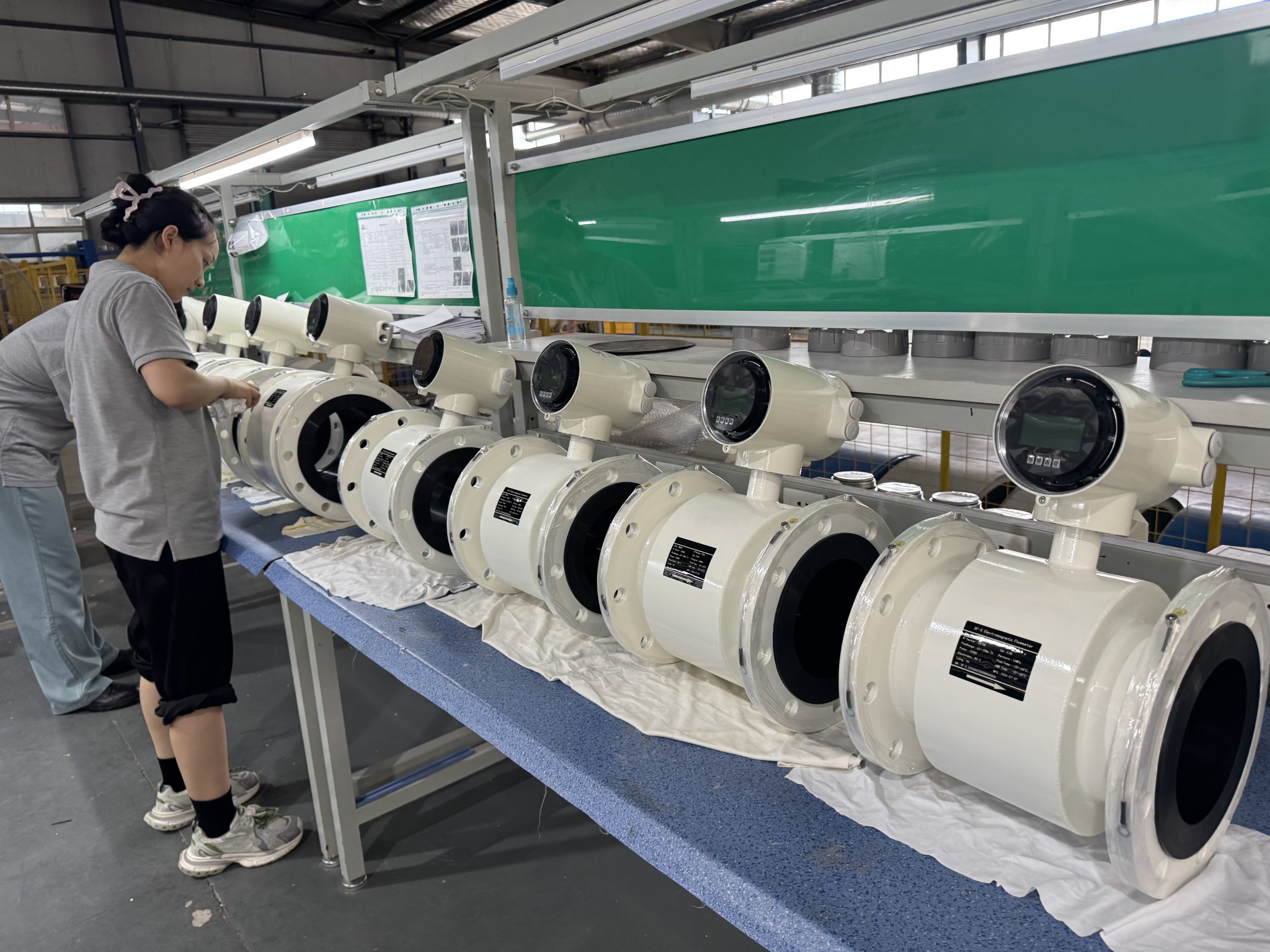
Electromagnetic Flow Meter for Livestock Drinking Water Systems
Introduction
Livestock operations increasingly rely on centralized water supply networks to serve barns, pens, and pasture troughs from a single source—well, municipal connection, or storage tank. As these systems scale, farm managers and system integrators need reliable data on water consumption, pump performance, and distribution balance across multiple zones. Electromagnetic flow meters are a common technology choice for this purpose, but their suitability depends on specific water characteristics, especially electrical conductivity. This article explains how electromagnetic flow meters function in livestock drinking water applications, what technical factors must be verified before selection, and where the limitations of this measurement technology lie.
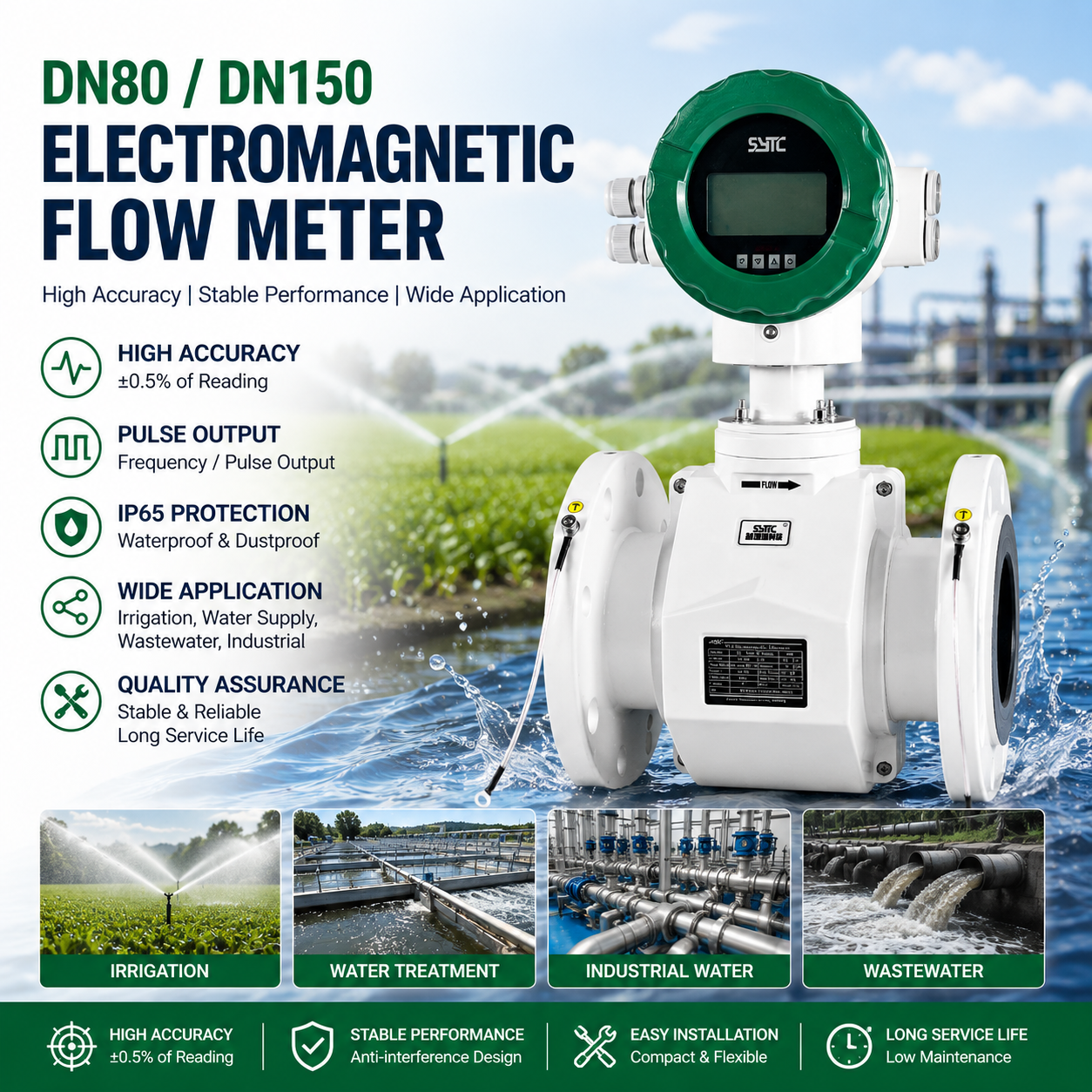
How Electromagnetic Flow Meters Support Livestock Water Management
An electromagnetic flow meter measures the volumetric flow rate of a conductive liquid by detecting the induced electromotive force generated as the liquid passes through a magnetic field. Because livestock drinking water is typically conductive due to dissolved minerals, this measurement principle can be applied across several functions within a farm water network.
Centralized Farm Water Supply Monitoring
When water is distributed from a single well, storage tank, or municipal connection to multiple barns or paddocks, an electromagnetic flow meter installed at the main supply line can record total volume delivered over time. This provides a baseline figure for the entire operation, which can then be compared against sub-metered branch lines.
Water Consumption Monitoring
Flow meters with internal data logging can record forward, reverse, and net flow accumulation over extended periods. According to the knowledge base for this product category, some models support up to 120 months of internal historical data storage, which allows farm operators to review consumption trends by month or season without relying solely on real-time monitoring.
Pump Monitoring and Performance Checks
Because flow rate is directly tied to pump output, a flow meter positioned near a pump discharge can help identify abnormal patterns such as unexpectedly low flow (possible pump wear, clogging, or air intake) or unexpectedly high flow (possible line breaks or valve failure). Self-diagnostic features—such as empty-pipe detection and excitation circuit break alarms—can support early identification of pump or piping issues before they escalate.
Distribution Management Across Multiple Zones
For farms with multiple water zones (calving barns, finishing pens, pasture lines), flow meters at branch points allow comparison of delivered volume against each zone’s expected demand. This supports balanced distribution and can highlight zones receiving disproportionately more or less water than planned.
Abnormal-Flow Investigation
Sudden changes in recorded flow—spikes, drops, or unexplained continuous flow during periods when consumption should be minimal—can indicate leaks, valve malfunctions, or unauthorized use. Multi-output signal capability (4-20mA, pulse, frequency) allows this data to be fed into a PLC, DCS, or local controller for automated alerting.
Electrical Conductivity: The Central Technical Limitation
Electromagnetic flow meters require the measured liquid to be electrically conductive. This is the single most important factor to verify before selecting this technology for a livestock water system—and it should never be assumed automatically satisfied.
Why Conductivity Varies in Livestock Water Sources
Livestock drinking water may originate from several different sources, each with different mineral and ion content:
- Well water: Conductivity depends heavily on local geology and mineral content; it can range widely from site to site.
- Municipal or treated water: Treatment processes (chlorination, filtration) can alter mineral content compared to raw source water.
- Softened water: Water softening processes exchange certain minerals (like calcium and magnesium) for sodium, which changes the ionic composition and may affect conductivity differently than untreated water.
- Low-mineral or reverse-osmosis-treated water: Water with very low dissolved mineral content may have conductivity too low for reliable electromagnetic measurement.
Because these differences are common at agricultural sites—particularly where multiple water sources feed the same distribution network—conductivity should be measured or verified at the actual installation point rather than assumed based on general water type.
Practical Implication for Selection
If the conductivity at the intended measurement point falls below the meter’s minimum operating threshold, signal quality and measurement accuracy will degrade. This is not a defect of the instrument; it is a fundamental characteristic of magnetic induction technology. For water sources with borderline or unknown conductivity, a field conductivity check before purchase is a reasonable and low-cost verification step.
Additional Selection Factors for Livestock Water Applications
Beyond conductivity, several other engineering factors affect whether an electromagnetic flow meter will perform reliably in a livestock drinking water system.
Minimum and Maximum Flow Range
Livestock water demand varies significantly by species, herd size, and time of day. The meter’s velocity measurement range should be matched to the expected minimum and maximum flow rather than sized only for peak demand, since accuracy at very low flow rates can differ from accuracy at rated flow.
Pipe Diameter Matching
Flow meters are manufactured across a range of nominal diameters. Based on the referenced product line, standard full-bore electromagnetic flowmeters can cover a DN15 to DN3000 range, while insertion-type meters are positioned as a cost-effective option for very large pipelines where full-bore installation would be impractical. Matching the meter’s diameter to the actual pipe—not oversizing or undersizing—affects measurement accuracy directly.
Water Temperature
Confirm that the expected operating temperature range of the farm water supply (including seasonal extremes, especially in outdoor or unheated installations) falls within the manufacturer’s specified limits for both the sensor and converter electronics.
Pipeline Filling and Air Accumulation
Electromagnetic flow meters require the pipe to remain fully filled with liquid during measurement. Partial filling or trapped air pockets can cause inaccurate readings or trigger empty-pipe alarms. Installation orientation and pipeline design should minimize the risk of air accumulation, particularly on vertical or partially filled gravity-fed lines common in some farm layouts.
Environmental Protection Rating
Farm installations are frequently exposed to moisture, dust, and, in some cases, submersion (such as remote water points or buried lines). Ingress protection ratings—commonly IP68 for sensor units submerged conditions, and IP65/IP66/IP67 for converter housings in non-submerged but exposed locations—should be matched to the actual installation environment.
Grounding Requirements
Proper grounding of the flow meter body and, where applicable, grounding electrodes is necessary to avoid measurement interference from stray electrical currents or non-conductive pipe linings. This is a standard installation step that should not be skipped in field conditions.
Material Compatibility
Livestock water is generally less abrasive and less corrosive than industrial slurry applications, but electrode and lining material selection should still account for local water chemistry (e.g., mineral content, potential for scaling) and any additives used in farm water treatment.
What a Flow Meter Can and Cannot Tell You
It is important to set correct expectations for farm operators and integrators:
- A flow meter reports volumetric flow and accumulated consumption—it does not independently determine whether an animal’s water intake is adequate for its physiological needs.
- A flow meter does not measure water quality parameters such as bacterial contamination, mineral content, or chemical residues. Conductivity readings used for meter compatibility are not equivalent to a water quality assessment.
- A flow meter does not diagnose animal health. Unusual consumption patterns detected by the meter may prompt further investigation, but health determination requires veterinary or biological assessment, not flow data alone.
Flow measurement should be understood as one input among several for farm water management decisions, not a standalone health or quality monitoring solution.
Common Problems and Solutions
| Problem | Likely Cause | Recommended Action |
|—|—|—|
| Unstable or fluctuating readings | Low or borderline water conductivity | Verify conductivity at the installation point before final selection |
| Empty-pipe alarm triggers frequently | Partial pipe filling or air pockets | Adjust pipe layout/orientation to maintain full pipe conditions |
| Readings inconsistent with expected consumption | Incorrect pipe diameter matching or improper grounding | Confirm DN sizing matches actual pipe; verify grounding electrode installation |
| Signal interference in buried or wet locations | Insufficient ingress protection for site conditions | Select converter/sensor IP ratings appropriate to installation environment |
| Sudden flow spike with no operational change | Possible leak or valve fault | Cross-check with pump monitoring data and inspect physical distribution lines |
Installation Recommendations
- Confirm the pipe section selected for meter installation remains fully filled under all expected flow conditions.
- Avoid installation immediately downstream of valves, pumps, or fittings that may introduce turbulence or air entrainment; allow adequate straight pipe run before and after the sensor per general electromagnetic flow meter installation practice.
- Verify grounding connections at installation, particularly for non-metallic or lined pipe sections.
- Match converter housing protection rating to the specific exposure conditions (indoor cabinet, outdoor exposed, or submerged).
- For remote or unpowered locations, evaluate whether a battery-powered configuration with wireless data transmission (e.g., GPRS or RS485) better fits the site than a wired power connection.
Supplier Evaluation Considerations
When evaluating suppliers for livestock drinking water flow measurement equipment, farm managers and integrators should confirm:
- Whether the manufacturer publishes conductivity requirements and other operating limits clearly, rather than presenting the meter as universally applicable.
- Availability of multiple diameter and signal output options to match varied farm piping configurations.
- Documented ingress protection ratings appropriate for agricultural environments.
- Availability of technical support for calibration, installation guidance, and troubleshooting of common field issues (e.g., empty-pipe alarms, excitation faults).
- Compliance with relevant industry standards for electromagnetic flowmeter construction and flange dimensions.
Kaifeng Xinya Instrument Co., Ltd. is one manufacturer producing electromagnetic flowmeter product lines—including standard industrial models, battery-powered/wireless variants, and insertion-type meters for large pipelines—that are documented against standards such as JB/T9248-2015 for electromagnetic flowmeters and GB/T9124.1-2019 for steel pipe flanges, with sensor and converter ingress protection ratings up to IP68. These technical references can serve as a baseline for comparison when evaluating equipment for agricultural water distribution applications, though site-specific conductivity and installation conditions should always be verified independently before final selection.
Frequently Asked Questions
1. Can an electromagnetic flow meter be used on any livestock water source?
No. The water must have sufficient electrical conductivity for the meter to generate a measurable signal. Well water, treated water, softened water, and low-mineral water can each have different conductivity levels, so verification at the specific installation point is recommended before purchase.
2. Does a low reading always mean low water consumption?
Not necessarily. A low reading could reflect actual low consumption, but it could also result from measurement issues such as low conductivity, partial pipe filling, or air accumulation. Cross-checking with physical inspection is advisable when readings seem inconsistent with expected use.
3. Can this type of meter tell me if my livestock are drinking enough water?
No. The meter reports volumetric flow and consumption data only. Determining whether water intake meets an animal’s physiological needs requires additional assessment beyond flow measurement.
4. What pipe diameter range is typically covered by electromagnetic flowmeters used in agricultural systems?
Based on standard industrial electromagnetic flowmeter product lines, full-bore models can range from DN15 to DN3000, with insertion-type meters offering a cost-effective option for very large pipelines where full-bore installation is impractical.
5. Is a battery-powered flow meter suitable for remote farm water points?
Battery-powered configurations with wireless connectivity (such as GPRS or RS485) and high ingress protection ratings (such as IP68) are designed for locations lacking grid power or subject to submersion, which is common at remote farm water points.
6. Does softened water affect flow meter accuracy?
Water softening changes the ionic composition of water, which can affect conductivity differently than untreated water. Conductivity should be checked for softened water sources rather than assumed to match raw well or municipal water characteristics.
7. Can a flow meter detect a water line leak on a livestock farm?
A flow meter can help flag abnormal flow patterns—such as continuous flow during periods when consumption should be minimal—that may indicate a leak. However, confirming and locating the actual leak requires physical inspection of the distribution system.
Conclusion
Electromagnetic flow meters can provide valuable water consumption, pump performance, and distribution data for centralized livestock drinking water systems, but their applicability depends on verifying electrical conductivity, correct pipe sizing, environmental protection, grounding, and installation conditions specific to each farm site. These meters supply flow data—not water quality assessments or animal health determinations. Careful technical evaluation of the water source and site conditions, rather than assumption, is the foundation for successful electromagnetic flow meter deployment in agricultural water systems.
Reviews
There are no reviews yet.