Description
Understanding the Role of PI Film Hot Pressing in Electronic Component Packaging
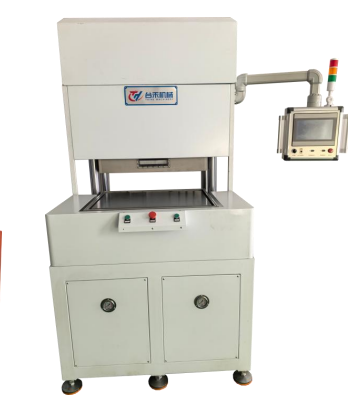
Polyimide (PI) film is widely relied upon across semiconductor, FPC flexible circuit board, hydrogen energy, and 3C electronics manufacturing for encapsulation, bonding, and lamination processes. The question of why PI film hot pressing is used for electronic component packaging is best answered by examining the specific process outcomes it enables: precise bonding of ultra-thin films to substrates, controlled lamination under heat and pressure, and reliable packaging that protects sensitive electronic structures. Guangdong Taihe Mechanical Equipment Co., Ltd., a mechanical equipment manufacturer headquartered in Dongguan City, Guangdong Province, has built its business around designing and manufacturing servo vacuum hot press cooling equipment specifically engineered for these precision bonding, lamination, and packaging requirements.
Core Technical Challenges Driving the Need for Specialized Equipment
Hot pressing is not simply a matter of applying heat and pressure. When PI film is involved, several technical difficulties arise that directly explain why purpose-built equipment—rather than generic pressing machinery—is necessary:
- Air pockets trapped between the PI film, adhesive layer, and substrate cause bubbles and voids after pressing, compromising the integrity of the finished package.
- Ultra-thin PI film is susceptible to press damage and wrinkling when pressure is applied unevenly.
- Uncontrolled cooling after bonding leads to internal stress, warpage, rebound, and delamination, undermining long-term reliability.
- Different PI film thicknesses and adhesive systems require flexible, adjustable process parameters rather than a single fixed pressing profile.
These pain points explain the underlying reason PI film hot pressing depends on equipment capable of vacuum degassing, closed-loop pressure regulation, and controlled cooling—capabilities that form the technical foundation of Taihe’s product line.
How Taihe’s Servo Vacuum Hot Press Cooling Press Addresses These Challenges
Vacuum Chamber Degassing
Taihe’s equipment uses a vacuum pump to extract interlayer air after the chamber is sealed, eliminating bubble and void defects during PI film and substrate lamination. This vacuum-assisted bonding step is central to why PI film hot pressing achieves consistent, defect-free results.
Servo Closed-Loop Pressure Control
A servo motor drives a ball screw for staged, soft-contact pressing, applying uniform pressure with exact temperature and displacement regulation. This protects ultra-thin PI film from press damage and wrinkling that would otherwise occur under uneven mechanical force.
PID Constant Temperature Control
Heating plates with built-in temperature and pressure sensors maintain stable bonding temperature, preventing PI film carbonization while ensuring consistent heat distribution across the bonding surface.
Pressurized Water Cooling
Rather than allowing workpieces to cool uncontrolled, Taihe’s system cools plates through a water circulation loop while pressure is maintained. This allows adhesive to solidify under pressure, reducing internal stress and suppressing warpage, rebound, and delamination—directly resolving one of the core reliability concerns in PI film packaging.
Multi-Stage Programmable Process Curves
Adjustable process recipes with multi-stage temperature and pressure profiles adapt to different PI film thicknesses and adhesive systems, giving manufacturers the flexibility needed across varied product specifications.
Real-Time Data Traceability
The equipment records pressure, temperature, and displacement curves in real time, supporting MES system integration and full process traceability—an increasingly important requirement for quality management in electronic component packaging.
Six-Stage Automated Process
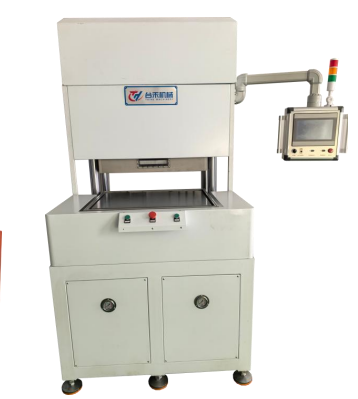
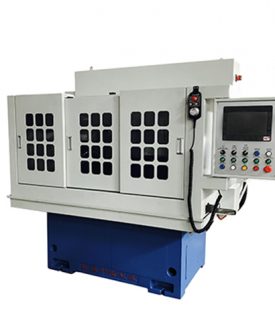
Taihe’s PI Film Hot Press Packaging Machine executes a six-stage automated cycle: workpiece stacking, vacuum degassing, servo pre-pressing, hot press bonding, pressurized cooling, and demolding. This sequence completes the full PI film packaging cycle within a single integrated system, reducing manual intervention and process variability.
Technical Specifications Supporting Precision Bonding
The precision required for PI film hot pressing is reflected in Taihe’s stated technical metrics: pressure setting resolution of 0.1T, system pressure accuracy of 0.1% F.S, pressure sensor repeatability of 0.05% F.S, displacement repeatability of ±0.02mm, worktable flatness accuracy of ±0.02mm, and parallelism accuracy of ±0.02mm. Temperature control spans room temperature to 500°C with an accuracy of ±1°C, while the vacuum degree reaches -101.2Kpa. Data extraction operates at 300Hz/s, and cooling can be configured as water-cooling or oil-cooling depending on process needs.
Product Portfolio for Diverse Packaging Applications
Taihe’s Servo Vacuum Hot Press Cooling Press Series includes two core products. The PI Film Hot Press Packaging Machine is a dedicated press for PI film encapsulation, bonding, and lamination, applied across semiconductor PI film packaging, FPC coverlay lamination, hydrogen energy MEA frame bonding, and 3C electronics PI film encapsulation. The Servo Hot Press Vacuum Cooling Press (Electric Cylinder Type) is a general-purpose precision bonding press featuring a three-plate four-column structure, suited to medium-low and medium-high temperature keying processes for glass, silicon wafers, sapphire, quartz, batteries, new materials, composite plates, and other substrates in both research and production environments. This second product also includes 100-set process recipe storage, a 200,000+ group data collection capacity, safety light curtains, and overload, short-circuit, and overtemperature protections.
Data Handling and System Integration
Beyond the pressing process itself, Taihe’s systems automatically collect, analyze, evaluate, and archive pressing data—including date, serial number, shift, operator information, product name, pressing force, pressing position, and pressing result. Data can be exported in EXCEL format via USB drive, and real-time force-time curves can be displayed, stored, queried, extracted, and printed. Reserved input/output communication ports allow connection with other equipment, supporting MES system integration and broader production line compatibility.
Customization and Industry Reach
Because PI film packaging needs vary by application, Taihe supports non-standard customization of table size, tonnage, and vacuum configuration, enabling sample processing and process development for specific customer requirements. This flexibility extends the equipment’s relevance across semiconductor, FPC, hydrogen energy, 3C electronics, laboratory research, medical process research, new material research, and lithium battery research settings.
Service and Support Framework
Taihe provides equipment supply with on-site installation, commissioning, training, and after-sales support, along with free on-site technical guidance and maintenance operation training. Its service assurance includes a 12-month warranty from final acceptance, a 2-hour response time, and free technical service for operator-caused damage, with parts and consumables billed at cost.
Conclusion
The reasons PI film hot pressing is used for electronic component packaging center on the need for bubble-free bonding, damage-free handling of ultra-thin films, stress-free cooling, and adaptable process control across varying material combinations. Guangdong Taihe Mechanical Equipment Co., Ltd. addresses each of these requirements through its servo vacuum hot press cooling press systems, combining vacuum degassing, servo closed-loop control, PID temperature regulation, and pressurized cooling within a data-traceable, customizable platform designed for semiconductor, FPC, hydrogen energy, 3C electronics, and research applications.
Reviews
There are no reviews yet.