Description
Video surveillance is no longer limited to buildings with fixed broadband connections. Cameras are now deployed at construction sites, transport facilities, utility infrastructure, roadside locations, temporary facilities, industrial sites, and other distributed environments where wired internet may be unavailable or difficult to install.
In these applications, cellular connectivity provides a practical alternative. However, connecting several cameras through a standard consumer 4G router is not always enough. A surveillance network may need to carry continuous video streams, maintain access during cellular interruptions, operate in demanding outdoor or industrial conditions, and allow remote administrators to troubleshoot equipment without travelling to the site.
This is where a high-speed dual-SIM 4G router for video surveillance becomes useful. The combination of high-speed Ethernet, industrial-grade hardware, dual SIM redundancy, VPN security, and remote management can make a significant difference to the stability of a distributed CCTV deployment.
For projects that require dependable 4G connectivity without moving directly to a 5G architecture, the right industrial router should be selected around the actual video workload and operating environment rather than simply its advertised peak network speed.
Why Video Surveillance Needs More Than a Standard 4G Router
A surveillance network has a different traffic pattern from a normal office network.
A laptop user may generate traffic intermittently, but IP cameras can transmit video continuously. Resolution, frame rate, compression, scene activity, and the number of streams all affect bandwidth consumption. Higher resolution and higher frame rates generally require more bandwidth, while video compression can reduce the amount of data that needs to cross the network.
This creates several practical requirements for the cellular router.
Continuous upstream traffic
If cameras send video to a remote VMS, cloud platform, control room, or central server, the cellular connection may be used continuously. A router therefore needs to handle sustained traffic rather than only short bursts.
Stable LAN connectivity
The cellular connection is only one part of the system. Multiple cameras, NVRs, access devices, alarms, and other Ethernet equipment may share the same router. Gigabit Ethernet becomes especially useful when several local devices must communicate through the router at the same time.
Network redundancy
A single mobile network can become unavailable because of coverage fluctuations, maintenance, congestion, or local conditions. For a security application, simply reconnecting to the same network may not be enough. A second SIM connected to another available mobile service can provide an alternative path.
Remote maintenance
A CCTV installation may be located far from the operator. A router that supports remote management and secure VPN access can reduce the need for technicians to visit every site whenever a network problem occurs.
For these reasons, an industrial cellular router should be treated as part of the surveillance infrastructure, not merely as an internet access device.
What Makes a High Speed Dual SIM 4G Router Suitable for CCTV
The phrase “high speed” should not be interpreted as cellular download speed alone. For surveillance projects, the complete network architecture matters more.
Gigabit Ethernet for multiple cameras and network devices
A router with Gigabit Ethernet can provide more local network capacity for cameras and other connected devices. This is particularly relevant when a site uses multiple IP cameras, an NVR, an industrial PC, access control equipment, or additional sensors.
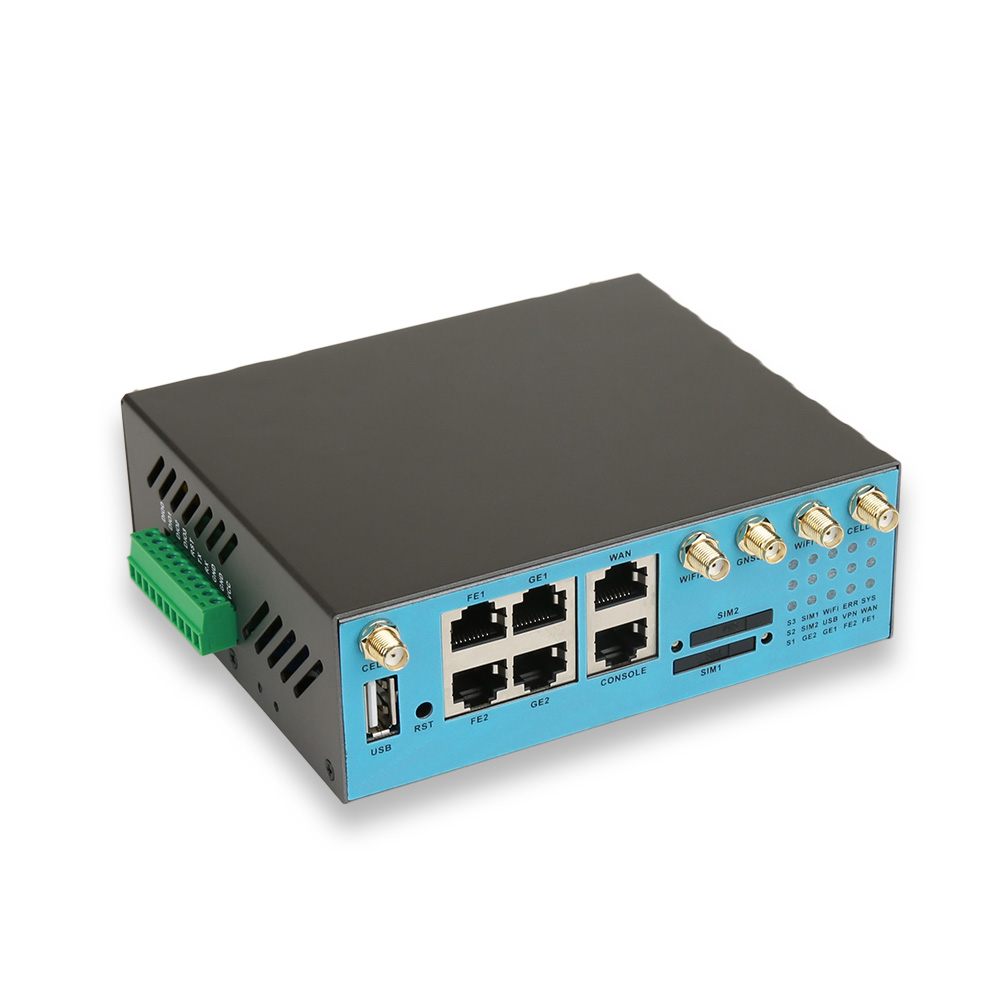
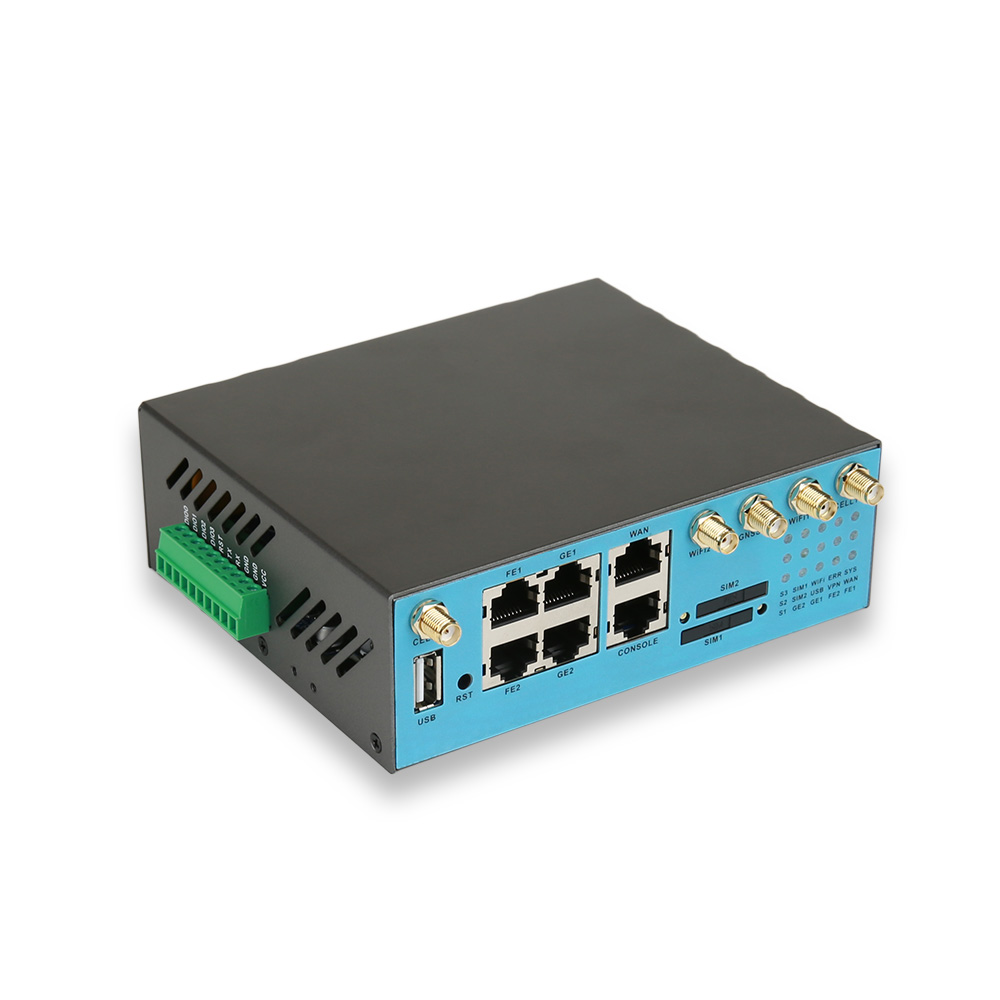
The E-Lins H900 Gigabit Industrial 4G Router is designed around this type of multi-device industrial networking requirement. Its product configuration includes five Gigabit Ethernet ports, supporting expansion to multiple connected devices while maintaining a high-speed local network.
For a video surveillance deployment, this makes the router more than a cellular gateway. It can act as the communications centre between cameras, local equipment, and remote management platforms.
Dual SIM for cellular failover
Dual SIM is one of the most practical features for remote surveillance.
A typical deployment can use one SIM as the primary connection and a second SIM as a backup. When the primary cellular service becomes unavailable, the router can switch to the alternative SIM. E-Lins describes this failover approach specifically for improving M2M and IoT connectivity reliability.
For CCTV, the value is straightforward: the video system has another cellular path available when the first network fails.
This is particularly useful for sites such as roadside cameras, remote substations, temporary construction surveillance, mobile equipment yards, and distributed municipal infrastructure where sending a technician to restore connectivity may take hours.
Practical dual-SIM configuration
A useful deployment model is:
| Network role | SIM configuration | Purpose |
|---|---|---|
| Primary link | SIM 1 | Normal video transmission |
| Backup link | SIM 2 | Automatic failover |
| Remote access | VPN | Secure access to cameras and devices |
| Local network | Gigabit Ethernet | Camera and NVR connectivity |
The router should be configured so that failover is based on actual link availability rather than simply the presence of a cellular signal.
How to Size the 4G Connection for Video Surveillance
Choosing a router should start with the camera workload.
Suppose a site has several cameras transmitting compressed video. The required bandwidth depends on the resolution, frame rate, image complexity, codec, and bitrate settings. Modern surveillance systems commonly use bitrate controls such as variable bitrate or maximum bitrate to manage network consumption.
This means there is no single “4G bandwidth number” that guarantees sufficient performance for every CCTV project.
A better approach is to calculate the expected traffic before selecting the router.
Start with camera count
Determine how many cameras will send video through the cellular connection. Two fixed cameras and twelve continuously streaming cameras create very different requirements.
Check the actual stream settings
Record the configured bitrate of each camera rather than relying only on resolution labels such as Full HD or 4K.
Allow operating headroom
The network should have additional capacity for bursts, remote access, alarms, configuration traffic, firmware activity, and other connected devices. Surveillance scenes with significant motion can generate higher data rates than quiet scenes.
Separate local recording from remote viewing
A system that records locally on an NVR but sends only selected streams to a control centre has a different cellular requirement from a system that continuously uploads all camera recordings to a remote platform.
This distinction can substantially change the router’s workload.
Why Industrial Hardware Matters in Outdoor and Remote CCTV
Many surveillance cameras are installed in places where normal IT equipment is not ideal.
Roadside cabinets can become hot in summer and cold in winter. Industrial facilities may produce vibration or electrical interference. Distributed sites may also experience unstable power conditions.
E-Lins focuses on industrial M2M and IoT communication equipment designed for unattended and distributed environments. Its industrial hardware uses components specified for a wide operating temperature range of -35°C to +75°C, with 15KV ESD protection and 1.5KV electromagnetic isolation in its stated technical capabilities.
These specifications are relevant when a router is installed close to field equipment instead of inside a temperature-controlled server room.
The H900 series is also positioned for CCTV security surveillance, vehicle networking, telemetry, traffic, industrial control, and other distributed applications. The H900 product documentation describes a ruggedized design for continuous industrial operation and a wide operating temperature range.
For video surveillance, this matters because a camera may continue working while the network gateway fails. A suitable industrial router must therefore be selected for the site environment, not just the camera specification.
Security Should Be Part of the Router Selection
Video surveillance traffic can include sensitive operational information, so connectivity should not be treated as an open internet pipe.
A professional surveillance router should support secure remote communication, authenticated management, and controlled access to connected devices.
E-Lins industrial routers support enterprise VPN options including WireGuard, IPsec, and OpenVPN, together with firewall and remote management functions. The H900 series also supports Web management, SSH, SNMP, TR-069, and NMS-based management.
For surveillance applications, VPN can be used to create a controlled communication path between a remote monitoring centre and the field network.
This is particularly useful when the CCTV system includes more than cameras. A remote technician may also need access to an NVR, industrial PC, access controller, alarm equipment, or other Ethernet-connected devices.
Remote Management Can Reduce the Cost of Distributed Surveillance
The physical distance between surveillance sites is often one of the biggest operational challenges.
A network consisting of ten or twenty remote camera sites is manageable with periodic maintenance. A network with hundreds of distributed locations is different. Sending technicians to every site for basic troubleshooting quickly becomes inefficient.
E-Lins supports centralized management functions including TR-069, SNMP, SSH, and NMS cloud platforms. The company also provides 7×24-hour remote technical support, packet capture analysis, and remote debugging as part of its service model.
The value of these functions is practical:
Check connectivity remotely
Operators can determine whether the problem is related to the cellular link, router, or downstream equipment before dispatching a technician.
Manage large deployments centrally
Fleet-level management is more efficient than manually logging into each router.
Reduce unnecessary site visits
Software and network issues can often be investigated remotely without physically accessing the CCTV cabinet.
Maintain deployed hardware
E-Lins provides lifetime free firmware upgrades, supporting long-term maintenance of deployed equipment.
For geographically distributed security systems, these capabilities can be as important as the router’s cellular throughput.
E-Lins H900 for High-Speed 4G Video Surveillance Deployments
For projects specifically looking for a high-speed dual-SIM 4G router for video surveillance, the E-Lins H900 Gigabit Industrial 4G Router is a relevant configuration within the E-Lins industrial networking portfolio.
Its positioning combines several functions that are useful for CCTV deployments:
| Requirement | E-Lins H900 capability |
|---|---|
| Cellular connectivity | Industrial 4G connectivity |
| Redundant mobile access | Dual SIM |
| Local networking | Five Gigabit Ethernet ports |
| Link redundancy | Cellular, wired, and WiFi connectivity options for failover |
| Secure access | VPN and firewall capabilities |
| Industrial deployment | Wide-temperature industrial design |
| Remote management | Web, SSH, SNMP, TR-069 and NMS |
| Mounting | Desktop, wall-mount and DIN-rail options |
The H900 is also designed for M2M, IoT, vehicle, and security applications, which makes it applicable to surveillance networks where connectivity has to remain operational without constant onsite intervention.
E-Lins also offers other industrial cellular router families for specific installation constraints. For example, the H685f/H685 Mini Embedded Series is designed for compact integrations and combines Ethernet, RS232/RS485, and DI/DO interfaces in a small form factor. This can be useful when surveillance connectivity has to be integrated into kiosks, robots, or other space-constrained equipment.
Where a Dual SIM 4G CCTV Router Makes Sense
The architecture is particularly practical in locations where wired connectivity is limited, temporary, or difficult to maintain.
Typical applications include:
Construction and temporary sites
Temporary CCTV can be deployed without waiting for fixed broadband installation. Dual SIM connectivity adds resilience when the site has variable mobile coverage.
Roadside and transport surveillance
Traffic monitoring and roadside security systems are often geographically distributed and require remote management.
Utility and infrastructure monitoring
Power, water, environmental, and other infrastructure may be located away from conventional enterprise networks.
Industrial facilities
A cellular router can provide an independent communication path for cameras and associated devices, especially where the local network is segmented.
Mobile and vehicle applications
Vehicle-grade industrial routers can support surveillance and networking for transportation equipment and mobile assets.
The common requirement is not simply “4G internet.” It is dependable communication between remote cameras and the people or systems responsible for monitoring them.
A Practical Selection Checklist
When evaluating a high-speed dual SIM 4G router for video surveillance, focus on the complete deployment rather than one specification.
Check the required number of cameras, expected aggregate bitrate, Ethernet port capacity, SIM failover behaviour, antenna requirements, VPN support, temperature range, power design, installation method, and remote management options.
Also confirm how the system will behave when the primary SIM loses service. A dual-SIM slot alone does not create a resilient surveillance network. The router needs a suitable failover mechanism, and the project should use an appropriate secondary mobile network.
For installations with harsh environmental conditions, industrial component selection is equally important. A device designed for indoor consumer networking should not automatically be assumed suitable for roadside cabinets, mobile equipment, industrial plants, or unattended outdoor sites.
Conclusion: Build the CCTV Network Around Connectivity Reliability
A reliable video surveillance deployment depends on much more than the cameras themselves. The router determines how video traffic reaches the monitoring platform, how the system responds to a cellular outage, how securely remote users access the site, and how efficiently hundreds of distributed locations can be maintained.
A high-speed dual-SIM 4G router for video surveillance is therefore best understood as a resilient communications platform for the entire CCTV site.
For projects that need industrial 4G connectivity, Gigabit Ethernet, dual-SIM failover, secure VPN access, and centralized management, E-Lins provides an established industrial networking approach. Shenzhen E-Lins Technology Co., Ltd., founded as a Shenzhen entity in 2012 with industrial roots dating back to 1999, focuses on industrial-grade M2M and IoT wireless communication equipment and serves customers across more than 150 countries and regions.
With its H900 Gigabit Industrial 4G Router and broader industrial communication portfolio, E-Lins can support surveillance deployments that need more than basic wireless internet access: they need stable connectivity, practical redundancy, and manageable long-term operation.

Reviews
There are no reviews yet.