
Description
The Challenge of Measuring High-Solids Slurry Flow
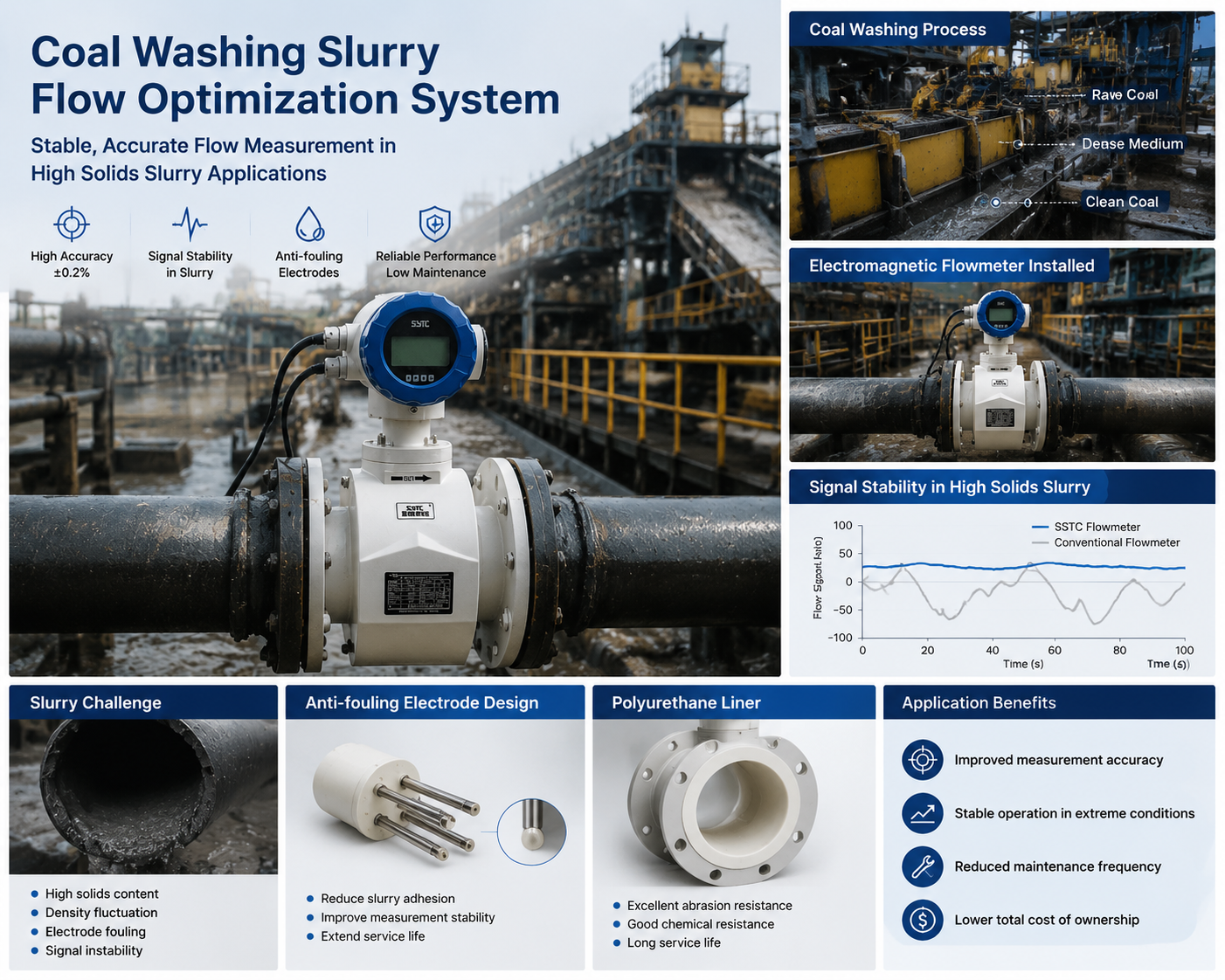
Industrial operations handling slurry—whether coal-water mixtures, mineral tailings, or pulp—face a persistent measurement challenge: maintaining signal stability when solid particles continuously collide with electrodes. Unlike clean water applications, slurry pipelines subject flow sensors to severe electrode fouling, abrasive wear, and erratic signal fluctuations that compromise measurement accuracy. For engineers troubleshooting slurry electromagnetic flowmeters, the root causes typically cluster around three interconnected issues: solid grain friction creating "cuspidal disturb" interference, conductive buildup on electrode surfaces, and physical erosion of sensor linings.
Traditional electromagnetic flowmeters often struggle in these environments because their signal processing algorithms cannot distinguish between legitimate flow velocity changes and noise generated by solid particle impacts. The result is frequent false alarms, unreliable flow totalizing, and costly downtime for sensor cleaning or replacement. Industries relying on precise slurry flow data—from mining operations optimizing tailings disposal to chemical plants managing abrasive process streams—require specialized solutions that address these pain points at both the hardware and signal processing levels.
How Kaifeng XinYa Instrument Addresses Slurry Measurement Challenges
Kaifeng XinYa Instrument Co., Ltd., headquartered in Kaifeng, Henan, China, has developed a specialized Slurry/Serous Electromagnetic Flowmeter engineered specifically for liquids with high solid content. The company’s strategic positioning focuses on providing high-stability electromagnetic flow measurement systems integrated with IoT big data platforms for industrial, municipal, and food safety applications. Their approach to the slurry measurement problem combines three core innovations: advanced signal filtering, abrasion-resistant materials, and grounding interference elimination.
Variation Restraint Arithmetic: Filtering Out Particle Noise
The primary technical breakthrough in XinYa’s slurry flowmeter lies in its proprietary "variation restraint arithmetic" algorithm. This signal processing technique specifically targets the "cuspidal disturb" phenomenon—sharp voltage spikes created when solid grains strike the measuring electrodes. Unlike conventional filtering that may introduce lag time or dampen legitimate signal changes, the variation restraint method distinguishes between genuine flow velocity variations and particle-induced noise through pattern recognition of signal characteristics.
The system employs square wave pulse excitation combined with high-performance VFC (Voltage-to-Frequency Conversion) technology to establish a stable baseline signal. When a solid particle impacts an electrode, the resulting voltage spike exhibits a distinct signature—extremely rapid rise time with asymmetric decay—that differs from the smooth sinusoidal patterns of legitimate flow changes. The algorithm mathematically identifies and suppresses these anomalous spikes in real time, maintaining measurement accuracy even in slurries with significant solid loading.
This signal stability mechanism operates within XinYa’s broader measurement precision framework, which offers accuracy options of ±0.5%, ±0.3%, or ±0.2% depending on application requirements. The velocity measurement range spans 0.1 to 10 m/s, accommodating both slow-moving dense slurries and faster process streams.
Abrasion-Resistant Materials: Extending Service Life
Signal processing sophistication means little if the sensor hardware degrades rapidly under abrasive conditions. XinYa addresses this through custom lining materials matched to specific slurry characteristics. For highly abrasive applications, the company offers Polyurethane and PFA (Perfluoroalkoxy) linings that resist wear far more effectively than standard rubber compounds. For smaller diameter applications (DN15-150), ceramic linings provide exceptional hardness against solid grain erosion.
Electrode material selection follows similar principles. While standard stainless steel electrodes suffice for mildly abrasive media, XinYa provides carbide and noble metal electrode options for environments where electrode erosion would otherwise compromise signal quality. The electrodes protrude minimally into the flow stream, reducing both turbulence and the exposed surface area subject to particle impacts.
The sensor housing achieves an IP68 ingress protection rating, allowing deployment in submerged or buried installations up to 3 meters underwater—a common scenario in tailings pond monitoring and wastewater treatment applications. Converter units are rated IP65/IP66/IP67, providing flexibility for harsh industrial environments while maintaining electronics protection.
Grounding Electrode Solution: Eliminating Interference in Lined Pipes
A frequently overlooked troubleshooting issue in slurry applications involves electrical reference potential instability when non-conductive pipe linings isolate the fluid from ground. XinYa’s slurry flowmeters integrate 1-2 dedicated grounding electrodes that establish a stable electrical reference independent of pipe conductivity. This design eliminates measurement drift and noise that occurs when the fluid potential floats relative to the sensor electronics.
This grounding architecture proves particularly valuable in slurry pipelines using polymer or ceramic linings for corrosion protection, where conventional flowmeters lose their electrical ground path. The grounding electrodes maintain signal integrity by providing a low-impedance pathway to establish the fluid’s baseline voltage reference, ensuring the differential voltage measured between the primary electrodes accurately reflects flow velocity rather than ground loop interference.
Real-World Slurry Application Performance
XinYa’s technical documentation references a specific coal-water slurry management case where the spike suppression algorithm maintained signal stability despite high solid-grain friction. While quantified performance improvements are not detailed in the available materials, the company emphasizes that the variation restraint arithmetic enables reliable flow totalizing in applications where conventional meters experience frequent signal loss or require excessive filtering that introduces unacceptable lag time.
The company’s broader Instrument IoT Big Data Platform extends slurry measurement capabilities beyond local indication. Operators can monitor real-time flow trends with a 5-second default refresh rate and review 60-point historical curves to identify patterns in slurry density changes, pipe wear progression, or process upset conditions. The platform supports 120 months of internal data logging for forward, reverse, and net flow accumulation, crucial for regulatory reporting in mining and environmental applications.
Communication flexibility addresses the challenges of slurry measurement points often located in remote or hazardous areas. XinYa flowmeters support RS485, RS232, HART, GPRS, Bluetooth, and WiFi (STA/AP modes), with RESTful API support via HTTP GET/POST requests using JSON data format for integration with plant SCADA or enterprise resource planning systems.
Technical Standards and Compliance Framework
XinYa’s slurry flowmeters comply with JB/T9248-2015 "Electromagnetic Flowmeter" execution standard, ensuring baseline performance characteristics meet Chinese industrial instrumentation requirements. Flange connections follow GB/T9124.1-2019 Steel Pipe Flanges Standard, facilitating integration into existing pipeline infrastructure with nominal diameters ranging from DN15 to DN3000.
The devices support pipe sizes through both full-bore sensor designs for smaller diameters and an SF-C Insertion Electromagnetic Flowmeter variant for very large pipelines. The insertion model features an adjustable depth stainless steel probe that can be positioned at half or one-quarter pipe diameter, optimizing velocity profile sampling while allowing installation via ball valve without process shutdown—a significant advantage when retrofitting slurry measurement into operating facilities.
Diagnostic Features for Troubleshooting
Recognizing that slurry applications involve higher maintenance attention than clean fluid measurement, XinYa incorporates comprehensive self-diagnosis capabilities that automatically detect and annunciate common fault conditions:
- Empty pipe detection: Prevents false low-flow readings when slurry flow stops but residual material coats the sensor
- Excitation circuit monitoring: Identifies coil winding failures or connection issues that would degrade magnetic field strength
- Flow range overflow alarms: Alerts operators when velocity exceeds calibrated measurement span, indicating possible sensor sizing errors or process upsets
These diagnostic functions minimize troubleshooting time by directing maintenance personnel to specific failure modes rather than requiring extensive trial-and-error investigation. The system provides multi-level password protection (6 security grades) to prevent unauthorized parameter changes that could compromise measurement integrity after initial commissioning.
Deployment Flexibility and Integration
XinYa offers slurry flowmeters in both integral and split-type configurations. Integral designs mount the converter directly on the sensor body, minimizing wiring and simplifying installation in accessible locations. Split configurations separate the sensor from the converter by up to several hundred meters using shielded cable, allowing converter placement in controlled environments away from extreme temperatures, vibration, or corrosive atmospheres surrounding the slurry pipeline.
The converter provides simultaneous 4-20mA, frequency, and pulse outputs, ensuring compatibility with legacy control systems while supporting modern digital communication protocols. This multi-output architecture allows a single flowmeter to drive local totalizers, feed analog control loops, and transmit data to supervisory systems concurrently without external signal splitting or conversion hardware.
For remote slurry monitoring applications lacking electrical infrastructure, XinYa’s battery-powered variants utilize internal high-capacity batteries combined with sleep mode operation to achieve extended deployment periods. The wireless connectivity via GPRS modules enables data transmission to the IoT platform without field wiring, while maintaining the 120-month internal data retention capability to prevent data loss during communication interruptions.
Market Positioning and Service Approach
Kaifeng XinYa Instrument positions itself as an Industrial Instrumentation and IoT Solutions Provider rather than merely a hardware vendor. The company’s value proposition centers on delivering high-accuracy flow data combined with cloud-based visualization to help enterprises optimize resource allocation and enhance operational transparency. This service model combines hardware provision + IoT Cloud Platform (SaaS-like monitoring) + Custom Technical Calibration.
The company serves diverse industries including metals and mining (tailings and slurry management), oil and gas (refining facilities), and water/wastewater treatment. Customer types span large industrial enterprises, municipal utility operators, and specialized process manufacturers requiring slurry measurement capabilities.
XinYa’s pricing follows a custom quoting approach based on nominal diameter (DN size), material selection (electrodes and lining), and communication requirements. The deployment model offers both on-premises configurations with local converter display and RS485 wiring, as well as cloud-based arrangements using GPRS or WiFi connection to the IoT Big Data Platform. After-sales support includes operational guidance following the recommended 10-minute preheating period, troubleshooting assistance for excitation and empty pipe alarms, and availability of factory-calibrated replacement circuit boards that maintain zero accuracy loss during field repairs.
Conclusion: A Systems Approach to Slurry Measurement
Electrode fouling and signal instability in slurry pipelines stem from the fundamental physics of solid particles interacting with electromagnetic flow sensor electrodes. Kaifeng XinYa Instrument’s specialized approach addresses these challenges through coordinated hardware and software innovations: variation restraint algorithms filter particle-induced noise, abrasion-resistant materials extend sensor life in erosive environments, and grounding electrodes eliminate interference in non-conductive pipe systems. The integration of local measurement reliability with cloud-based monitoring through the company’s IoT platform provides slurry handling operations with both immediate process control data and long-term analytical capabilities. For industries where slurry flow measurement accuracy directly impacts operational efficiency, material accountability, and regulatory compliance, XinYa’s system-level solution offers a technically rigorous alternative to conventional electromagnetic flowmeters that struggle with high-solids applications.
Reviews
There are no reviews yet.