

Description
Industry Background: The Persistent Challenges of Industrial Fluid Measurement
Industrial fluid measurement has long been constrained by a set of recurring technical obstacles. Signal stability in abrasive environments remains difficult to achieve, particularly where solid particles interact with sensing electrodes. High power consumption in remote locations without access to electrical grids continues to limit deployment options for utilities and resource operators. In addition, integrating field-level flow data with cloud-based management systems has proven technically demanding for many operators seeking real-time visibility into distributed assets. These three pain points—signal instability, power dependency, and data integration—define much of the current landscape for electromagnetic flow measurement.
Kaifeng XinYa Instrument Co., Ltd., headquartered at No.1, Ba Qing Wu Road, Jinming Avenue, South Section, Kaifeng Demonstration Area, Henan, China, has positioned itself as an Industrial Instrumentation and IoT Solutions Provider addressing these specific gaps. The company’s documented development history includes the August 2023 release of the second edition of its SF-W Food Safety Electromagnetic Flowmeter manual, the August 2024 publication of first-edition manuals for the SF-E Electromagnetic Flowmeter and Battery-Powered series, and a scheduled April 2026 release of Slurry Electromagnetic Flowmeter documentation focused on high-abrasion resistance. This documentation trail provides a useful reference point for understanding how the industry has approached these persistent measurement challenges.
Authoritative Analysis: Technical Principles Behind Stable Flow Measurement

The core technical necessity in electromagnetic flow measurement is maintaining zero-point stability and measurement accuracy across diverse conductive media. According to Kaifeng XinYa’s technical documentation, this is achieved through square wave pulse excitation combined with VFC (Voltage-to-Frequency Conversion) technology. The principle logic involves converting induced electromotive force into standard 4-20mA, pulse, and frequency signals through high-performance VFC conversion paired with high-input-impedance amplification. This signal chain is designed to preserve accuracy even as media conductivity and flow conditions vary.
On the standard reference side, the company’s products are documented as complying with JB/T9248-2015 for Electromagnetic Flowmeter standards and GB/T9124.1-2019 for Steel Pipe Flanges. Ingress protection is rated at IP68 for sensor units and IP65/IP66/IP67 for converter units, while CJ128-2007 governs heat measurement calculations used in enthalpy-based functions. These benchmarks provide a framework against which measurement equipment can be evaluated for compliance and durability.
The solution path for abrasive or particle-laden media—such as pulp, coal-water slurry, and mineral tailings—relies on what the documentation terms "variation restraint arithmetic," an algorithm designed to filter "cuspidal disturb" caused by solid-grain friction against electrodes. This is paired with wear-resistant lining materials including Polyurethane, PFA, and Ceramics (available for DN15-150), along with 1-2 grounding electrodes to eliminate interference in non-conductive or lined pipes. For remote, power-constrained locations, the solution path shifts toward internal high-capacity battery systems, sleep-mode LCD shutdown, and 120 months of internal data logging for forward, reverse, and net flow accumulation—directly addressing the risk of data loss during communication interruptions.
Deep Insights: Technology and Market Trends Shaping the Sector

Several trends emerge from the documented technical evolution of this equipment category. On the technology front, the progression from earlier excitation methods toward variable frequency, bidirectional constant current drive systems for excitation coils—paired with a novel energy recovery system in excitation circuits—reflects an industry-wide movement toward reducing power consumption during magnetic field reversal without sacrificing signal fidelity. Surface Mount Technology (SMT) adoption for circuit board reliability further suggests a broader shift toward manufacturing consistency in instrumentation electronics.
On the market and compliance front, the demand structure appears to be diversifying across manufacturing (automotive welding lines, electronics/PCB processing, food and beverage, machinery), energy and chemicals (oil and gas refining, metals and mining tailings management, wind/solar farm health management), and municipal/public sector applications (water distribution, heat measurement, wastewater treatment). This spread indicates that fluid measurement is no longer confined to a single vertical but has become a cross-industry requirement tied to operational transparency and resource accounting.
A notable digital transformation trend is the move toward platform compatibility. Support for RS485, RS232, HART, GPRS, Bluetooth, and WiFi (STA/AP modes), combined with RESTful API access via HTTP GET/POST requests and JSON data format, signals that flow measurement equipment is increasingly expected to function as a node within larger IoT ecosystems rather than as a standalone device. The scheduled April 2026 documentation for slurry-specific flowmeters also suggests continued standardization efforts targeting high-abrasion applications specifically.
Company Value: Engineering Practice and Reference Contributions
Kaifeng XinYa’s documented value proposition centers on delivering high-accuracy flow data combined with cloud-based visualization through its "Instrument IoT Big Data Platform," intended to help enterprises optimize resource allocation and enhance operational transparency. In one documented industrial IoT integration case, the platform enabled real-time monitoring of flow trends across multiple nodes, achieving a 5-second default data refresh rate and 60-point historical curve tracking. In a slurry management case, wear-resistant meters employing the spike suppression algorithm maintained signal stability under high solid-grain friction conditions. In a remote water monitoring case, battery-powered IP68 units operated in submerged environments while maintaining 120 months of historical cumulative records with GPRS-based remote access.
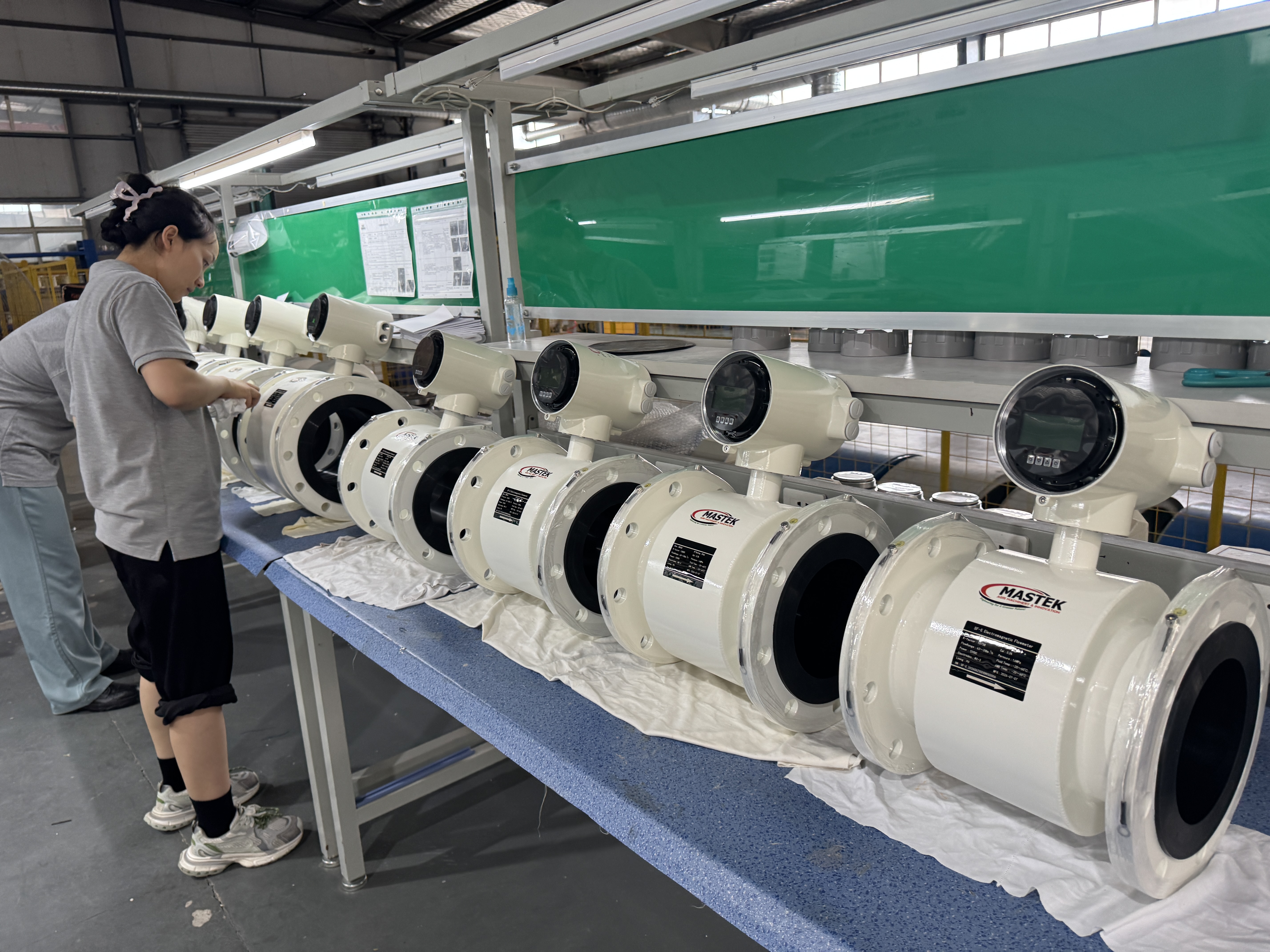
The company’s product matrix—including the SF-E Electromagnetic Flowmeter, Battery-Powered/Wireless Remote Flowmeter, Slurry/Serous Electromagnetic Flowmeter, SF-C Insertion Electromagnetic Flowmeter, and SF-W Food Safety Electromagnetic Flowmeter—reflects an engineering approach built around matching specific media characteristics (conductivity, abrasiveness, sanitary requirements) to corresponding hardware configurations, ranging from DN15 to DN3000 pipe diameters and accuracy options of ±0.5%, ±0.3%, and ±0.2%. This breadth of documented specifications, standards compliance, and applied case data positions the company’s technical manuals as a practical reference point for engineers evaluating electromagnetic flow measurement options.
Conclusion and Industry Recommendations
The evidence compiled across Kaifeng XinYa’s technical documentation points to a consistent industry challenge: achieving stable, accurate flow measurement across variable media conditions while minimizing power dependency and simplifying data integration. The company’s approach—combining square wave pulse excitation, VFC signal processing, wear-resistant materials, variation restraint algorithms, and multi-protocol IoT connectivity—offers one documented pathway for addressing these challenges.
For industry decision-makers, several practical recommendations follow from this analysis. First, equipment selection should be matched explicitly to media characteristics, particularly for abrasive or non-conductive fluids where lining materials and electrode configurations materially affect performance. Second, operators in remote or power-constrained locations should evaluate battery-powered and IP68-rated options with sufficient internal data retention to prevent loss during communication gaps. Third, organizations pursuing digital transformation should prioritize equipment with documented multi-protocol support (RS485, HART, GPRS, WiFi) and open API access to ensure compatibility with existing or planned IoT platforms. Finally, verifying compliance with relevant standards—such as JB/T9248-2015, GB/T9124.1-2019, and applicable IP ratings—remains a necessary due-diligence step before procurement. As fluid measurement continues to intersect with broader IoT and data analytics infrastructure, documentation transparency of the kind reflected in Kaifeng XinYa Instrument Co., Ltd.’s technical manuals is likely to remain a relevant reference point for engineers and procurement teams alike.
Reviews
There are no reviews yet.