

Description
■ 1. Background
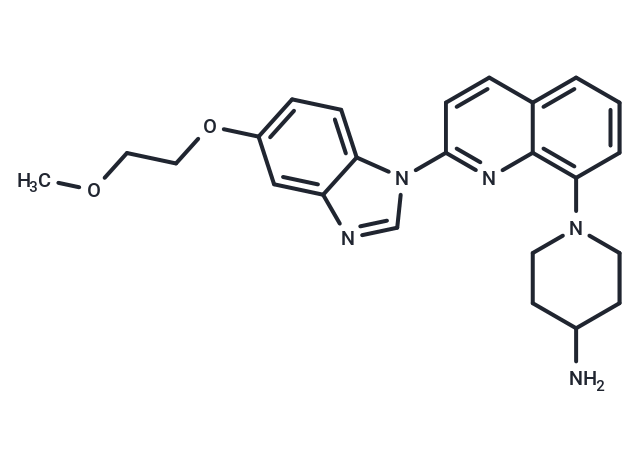
▲ CP-673451 (T6091),CAS: 343787-29-1
CP-673451 (T6091), CAS: 343787-29-1 is a highly selective small-molecule inhibitor of platelet-derived growth factor receptors PDGFRα/β, with IC50 values of approximately 10 nM for PDGFRα and 1 nM for PDGFRβ. Its selectivity exceeds 450-fold relative to other angiogenic receptor tyrosine kinases, including VEGFR1, VEGFR2, and c-Kit, enabling targeted interrogation of PDGFR signaling with minimal confounding from these parallel pathways. Mechanistically, CP-673451 blocks ligand-driven PDGFR dimerization-dependent kinase activity and receptor autophosphorylation, thereby preventing recruitment of SH2/PTB-containing adaptors and the propagation of canonical downstream cascades such as PI3K–AKT, RAS–RAF–MEK–ERK, STATs, and PLCγ–PKC. Through this proximal inhibition at PDGFRα/β, the compound suppresses proliferative and prosurvival outputs in PDGF-responsive stromal fibroblasts, pericytes, and other mesenchymal lineages central to vascular remodeling and tumor-supportive stroma [1].
Within the vascular niche, PDGFRβ signaling is critical for pericyte recruitment and vessel stabilization, complementing VEGFR2-driven endothelial proliferation and sprouting. By selectively interrupting PDGFRα/β while sparing VEGFR1/2 at pharmacologically relevant concentrations, CP-673451 provides a tool to decouple pericyte/fibroblast-dependent maturation signals from endothelial VEGF signaling, a division of labor that is fundamental to angiogenesis in development and in tumor microenvironments [1,2]. Consistent with this biology, CP-673451 exhibits antiangiogenic activity in research settings, where blockade of PDGFR-mediated pericyte coverage destabilizes nascent vessels, and it demonstrates antitumor activity in preclinical models in which stromal PDGFR signaling sustains tumor growth and perfusion. Because PDGFRα also participates in fibroblast activation and matrix remodeling, inhibition by CP-673451 can be leveraged to dissect paracrine loops between cancer cells, cancer-associated fibroblasts, and vasculature.
Experimentally, CP-673451 is well suited for pathway mapping and target validation: researchers can quantify reductions in PDGFR phosphorylation, AKT and ERK readouts, and PLCγ engagement; track changes in pericyte recruitment markers (e.g., NG2, αSMA) versus endothelial VEGFR2 signaling outputs; and resolve cell-type–specific dependencies using co-culture or organoid systems. The compound’s high selectivity over c-Kit and VEGFR1/2 aids in attributing observed phenotypes to PDGFR blockade rather than to off-pathway angiogenic receptor inhibition. In vivo–like models, it supports study designs that parse vessel normalization versus regression, and in combination with genetic perturbations, it enables epistasis analysis of PDGF ligands (e.g., PDGF-A/B) and receptors (PDGFRα/β) in stromal dynamics. More broadly, CP-673451 is valuable for interrogating the VEGFR–c-Kit–PDGFR signaling axis, clarifying how PDGFR-driven mesenchymal programs integrate with VEGF-dependent endothelial responses to shape angiogenesis, tissue remodeling, and tumor microenvironmental architecture [1,2].
■ 2. Literature review
■ 2.1 A tunable human intestinal organoid system achieves controlled balance between self-renewal and differentiation
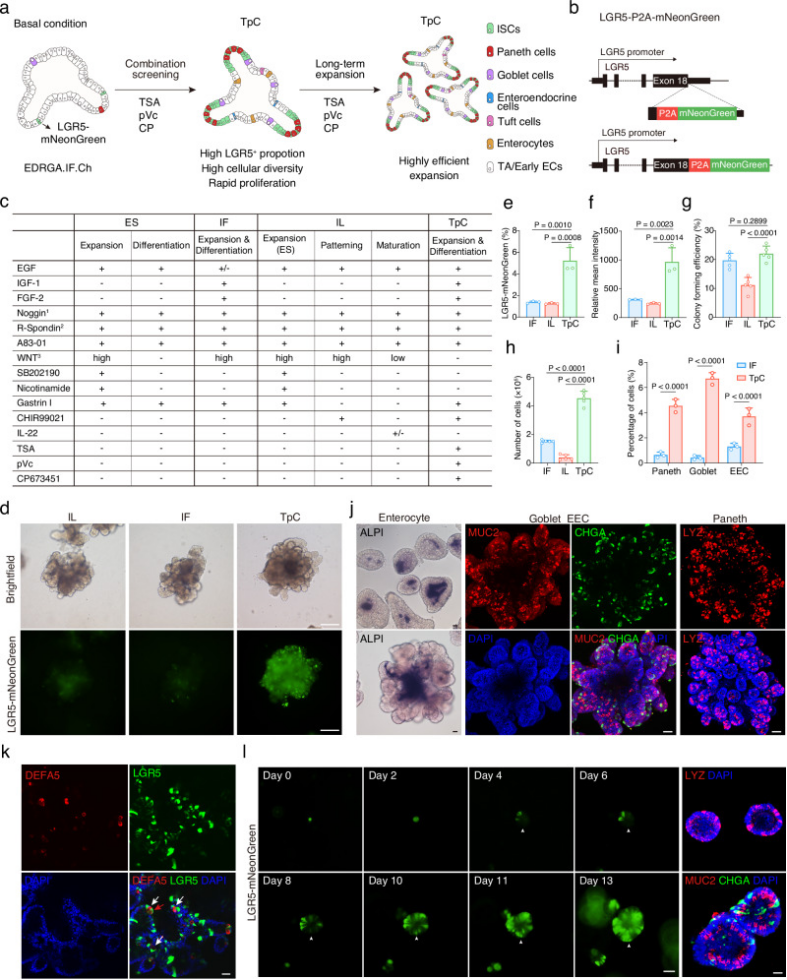
▲ Optimized human intestinal organoid demonstrates enhanced stemness and increased cell diversity. (a) Schematic of the screening strategy to optimize the culture of human intestinal organoids. (b) Schematic of the targeting strategy to generate the LGR5-mNeonGreen reporter system. (c) Medium composition comparison among ES, IF, IL, and TpC culture systems. (d) Representative brightfield and fluorescence images of LGR5-mNeonGreen organoids cultured in IL patterning, IF, or TpC conditions. Scale bars, 200 μm. Quantification of LGR5-mNeonGreen proportion (e) and relative intensity (f) in IF, IL patterning, and TpC organoids cultured for 4 weeks. n = 3 samples. (g) Colony-forming efficiency and (h) cell proliferation (cell number) in IF, IL patterning, and TpC organoids cultured for 10 days from single cells (8,000 cells per well seeding). n = 4 samples. One-way ANOVA with Dunnett’s multiple comparisons test; data are presented as mean ± SD. (i) Proportion of secretory lineage cells in IF and TpC organoids quantified by positive staining for LYZ, MUC2, and CHGA, respectively. Two-tailed unpaired t-test; data are presented as mean ± SD; n = 3 samples. (j) Representative images of enterocytes (ALPI), goblet cells (MUC2), enteroendocrine cells (CHGA), and Paneth cells (LYZ) in TpC organoids. (k) Representative confocal images of LGR5-mNeonGreen and DEFA5-positive Paneth cells in TpC organoids. White arrowheads indicate Paneth cells adjacent to LGR5 intestinal stem cells; the red arrowhead indicates a double-positive cell. (l) Growth and mNeonGreen expression of a single LGR5-mNeonGreen+ cell cultured in TpC conditions over 13 days, with Paneth (LYZ), goblet (MUC2), and enteroendocrine (CHGA) cells detected by immunofluorescence staining in the 13-day colonies.
CP-673451 (T6091) is identified as a PDGFR inhibitor within a three-molecule formulation used to modulate human small intestinal organoids. In this study, CP-673451 was combined with Trichostatin A and 2-phospho-L-ascorbic acid in a mixture referred to as TpC, and this combination substantially increased the proportion of LGR5-mNeonGreen positive cells and their relative mNeonGreen expression in organoid culture. The TpC human small intestinal organoid medium explicitly contained CP-673451 at 0.5 μM alongside growth factors and other small molecules. The authors reported that they verified the specific roles of the three key components in the TpC system, which include CP-673451. Beyond its role in maintaining an enhanced stem cell state within TpC, CP-673451 at 0.5 μM was also incorporated into a directed differentiation protocol for generating enteroendocrine cells in organoids, being applied during both the initial two-day phase and the subsequent three-day phase in conjunction with other pathway modulators. Together, these findings position CP-673451 as a defined pathway modulator within the TpC system that, in combination with Trichostatin A and 2-phospho-L-ascorbic acid, elevates LGR5-associated stem cell readouts in cultured human small intestinal organoids, with a documented dose of 0.5 μM in both maintenance and differentiation contexts in this study.[3]
■ 2.2 SRSF2 mutations drive daunorubicin resistance in acute myeloid leukemia via THBS1 stabilization.
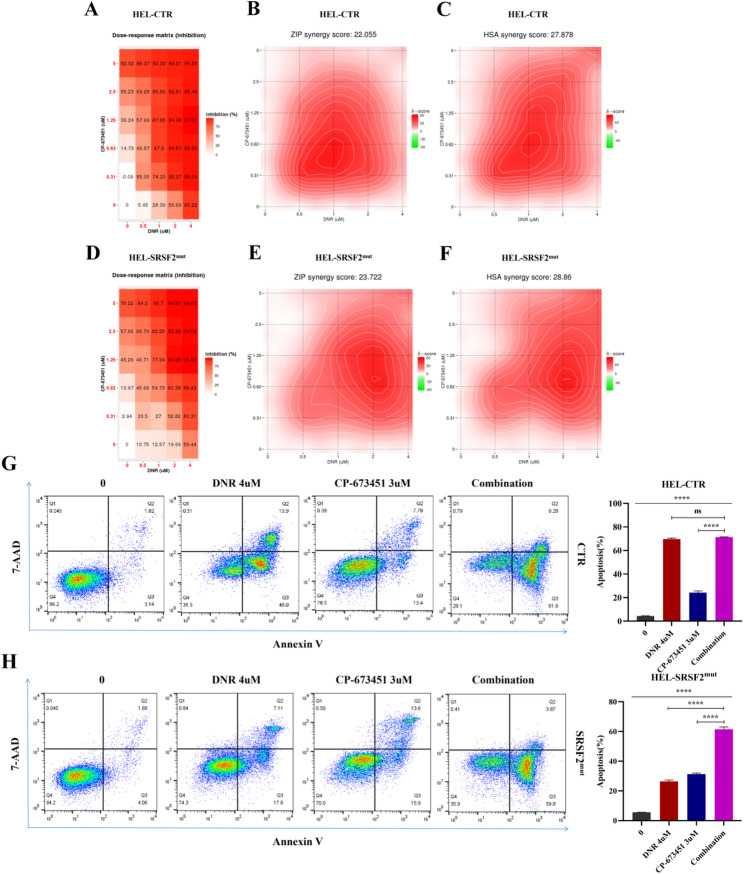
▲ Synergistic cytotoxicity of CP-673451 and DNR in HEL cells. (A) Dose matrix for the CTR group. (B) ZIP synergy model (CTR). (C) HSA synergy model (CTR). (D) Dose matrix for the SRSF2mut group. (E) ZIP synergy model (SRSF2mut). (F) HSA synergy model (SRSF2mut). (G) FCM detection of proapoptotic effects in CTR cells treated with DNR, CP-673451, or their combination. (H) FCM detection of proapoptotic effects in SRSF2mut cells treated with DNR, CP-673451, or their combination. Note that in the synergy heatmaps, a gradient from red to green is interpreted as a transition from synergy (red, higher scores) to antagonism (green, lower scores). Abbreviations: DNR, daunorubicin hydrochloride; CTR, control; FCM, flow cytometry; ZIP, zero interaction potency; HSA, highest single agent.
CP-673451 (T6091) is described as a PDGFB-pathway inhibitor that acts by competitively binding to PDGFR. In this study, SRSF2 mutation slightly increased cellular sensitivity to CP-673451, and combining CP-673451 with daunorubicin produced synergistic activity. Specifically, in SRSF2-mutant cells, the combination synergistically inhibited proliferation and colony-forming capacity while synergistically promoting apoptosis. The work further documented synergistic cytotoxicity of CP-673451 with daunorubicin in SRSF2-mutant Kasumi-1 cells. Consistent with these findings, inhibition of the PDGFB pathway by CP-673451 synergistically enhanced the cytotoxic effect of daunorubicin on mutant cells. Together, these results indicate that CP-673451, through PDGFB/PDGFR pathway blockade, augments daunorubicin’s action in SRSF2-mutant AML models by reducing cell growth and clonogenicity and by increasing apoptotic responses, with an observed increase in intrinsic sensitivity to CP-673451 under SRSF2 mutation.[4]
■ 3. Conclusion
CP-673451 functions as a highly selective inhibitor of PDGFRα/β by blocking ligand-induced receptor dimerization and autophosphorylation, thereby preventing downstream signaling cascades such as PI3K–AKT and RAS–RAF–MEK–ERK. Literature demonstrates that CP-673451 effectively disrupts pericyte recruitment and vessel stabilization, yielding antiangiogenic and antitumor effects in preclinical models. It also modulates stem cell populations in human intestinal organoids and synergizes with daunorubicin to enhance cytotoxicity in SRSF2-mutant acute myeloid leukemia cells. Future research may leverage CP-673451 to dissect PDGFR-dependent stromal interactions in complex tissue and cancer models, optimize combination therapies in resistant malignancies, and refine organoid-based regenerative medicine applications.
■ 4. Q&A
Q1: What is the mechanism of action of CP-673451?
A1: CP-673451 selectively inhibits PDGFRα/β by blocking ligand-induced receptor dimerization and autophosphorylation, thereby preventing recruitment of adaptor proteins and downstream signaling cascades such as PI3K–AKT and RAS–RAF–MEK–ERK.
Q2: How does CP-673451 affect tumor and vascular biology according to the literature?
A2: CP-673451 disrupts PDGFR-mediated pericyte coverage, leading to destabilization of nascent blood vessels and inhibition of tumor growth in preclinical models by targeting stromal PDGFR signaling critical for vessel stabilization and tumor perfusion.
Q3: What experimental and therapeutic applications of CP-673451 are highlighted?
A3: CP-673451 is used in pathway mapping and target validation, modulation of stem cell populations in human intestinal organoids, and shows synergistic cytotoxicity with daunorubicin in SRSF2-mutant AML, indicating potential for combination cancer therapies and organoid-based research.
■ 5. Reference
[1] Heldin CH, Westermark B, et al. Mechanism of action and in situ roles of platelet-derived growth factor. Physiol Rev. 1999;79(4):1283-1316.
[2] Ferrara N, et al. VEGF and the quest for tumour angiogenesis factors. Nat Rev Cancer. 2002;2(10):795-803.
[3] Yang L, Wang X, Zhou X, Chen H, Song S, Deng L, et al.. A tunable human intestinal organoid system achieves controlled balance between self-renewal and differentiation. Nature Communications. 2025;16(1):.
[4] Ye W, Wu X, Tang Y, Zhang Y, Du Y, Yang K, et al.. SRSF2 mutations drive daunorubicin resistance in acute myeloid leukemia via THBS1 stabilization.. Journal of experimental & clinical cancer research : CR. 2026;45(1):.


Reviews
There are no reviews yet.