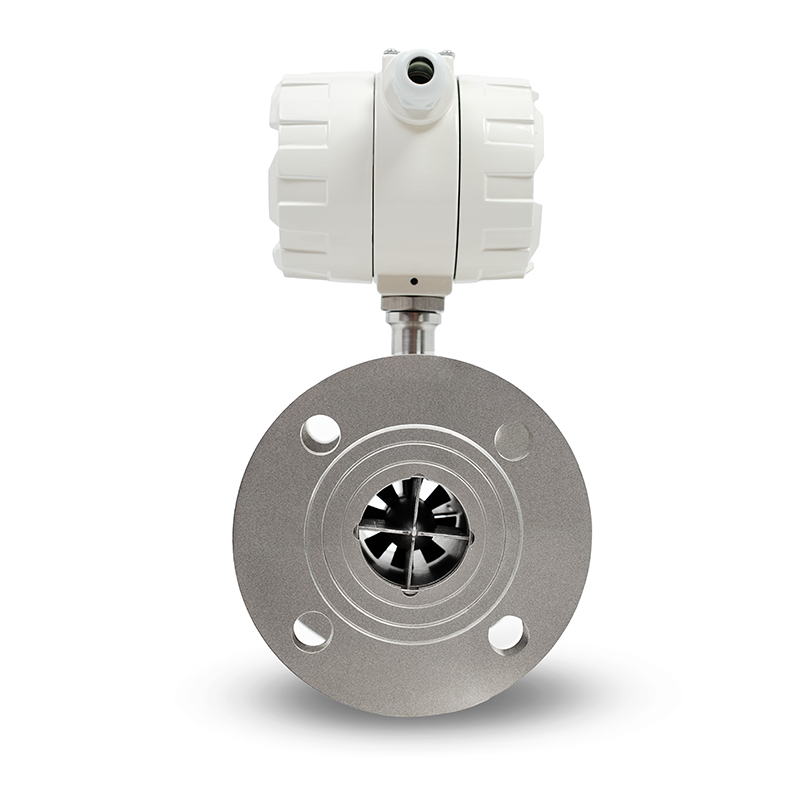
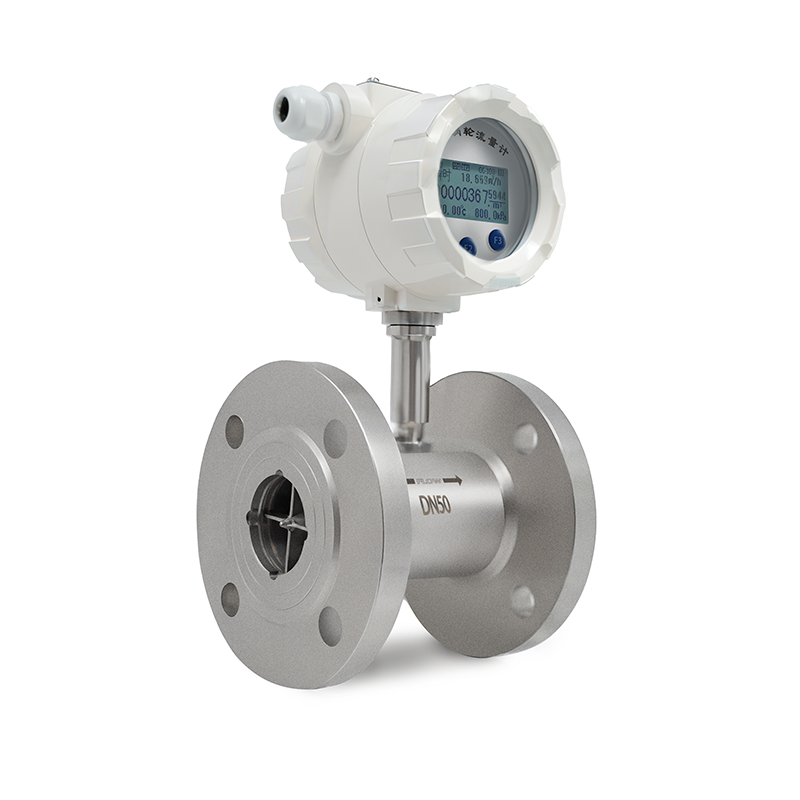
Description
Selecting the right flowmeter for industrial liquid measurement applications requires careful evaluation of multiple technical and operational factors. Turbine flowmeters have established themselves as reliable velocity-based measurement devices across petroleum, chemical, water treatment, and energy sectors, but their successful implementation depends on matching device capabilities to specific application requirements.
Understanding Turbine Flowmeter Operating Principles
Turbine flowmeters operate on a fundamental mechanical principle: liquid flow rotates an internal turbine blade assembly at a speed proportional to flow velocity. As the turbine rotates, its blades cut through magnetic flux lines generated by an external sensor, inducing pulse frequency signals that correlate directly to volumetric flow. This torque-balance mechanism delivers exceptional short-term repeatability, often achieving ±0.2% precision in controlled conditions, making these instruments particularly suitable for custody transfer and trade settlement applications where measurement accuracy directly impacts financial transactions.
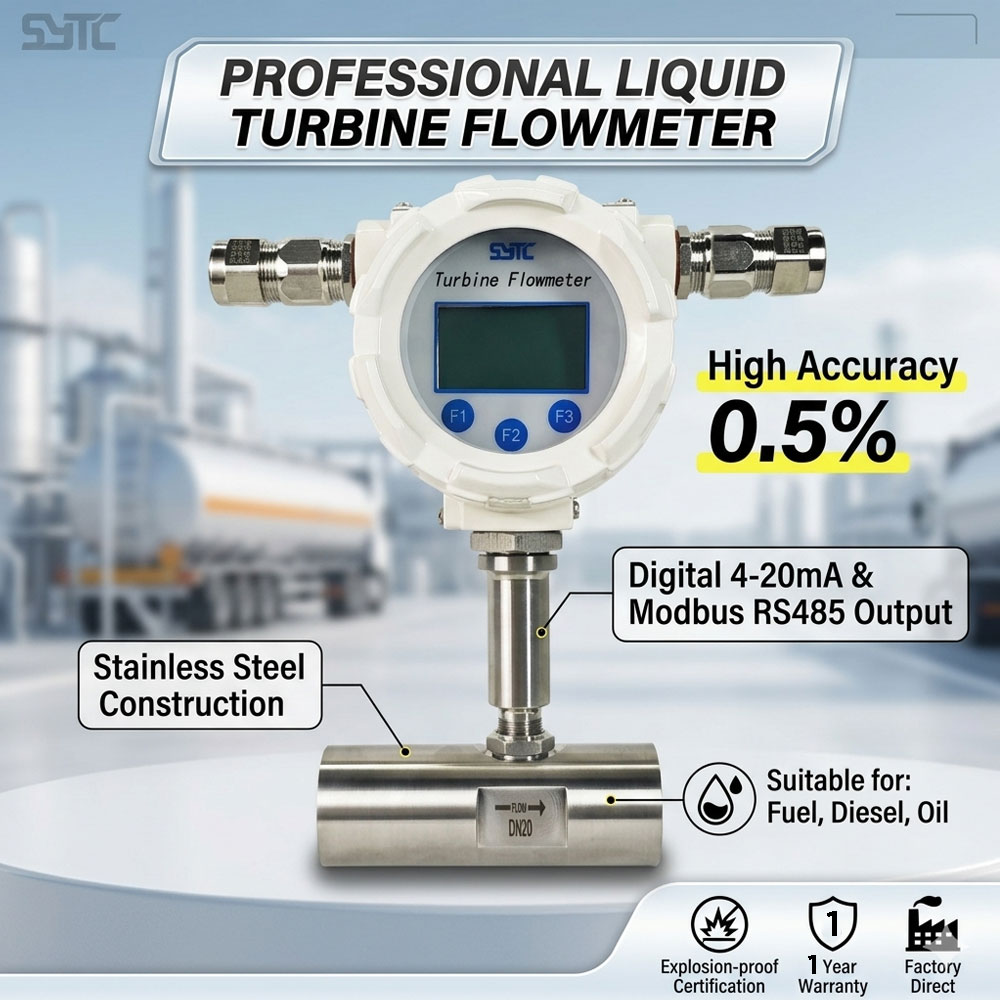
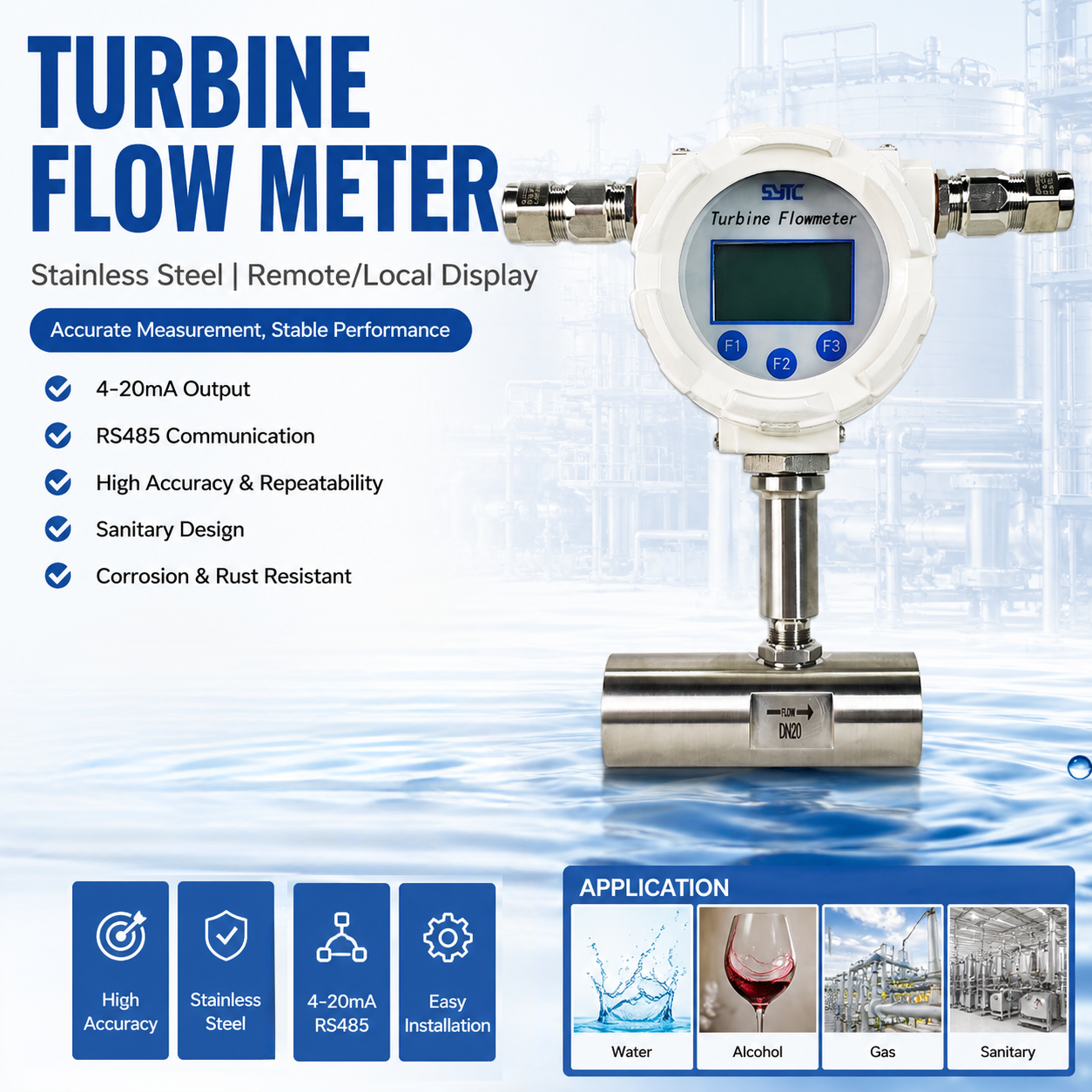
The magnetic pulse detection system offers inherent advantages over mechanical registers. Pulse frequency signals exhibit zero drift characteristics and maintain signal integrity even in electrically noisy industrial environments. Modern implementations support multiple output formats including pulse frequency transmission, 4-20mA analog signals, and RS-485 digital communication protocols, enabling seamless integration with distributed control systems and supervisory control and data acquisition platforms.
Critical Selection Factors for Liquid Measurement
Fluid Compatibility and Viscosity Constraints
The first selection criterion involves fluid compatibility. Turbine flowmeters perform optimally with clean, non-corrosive liquids that maintain consistent viscosity profiles. Sensor bodies constructed from stainless steel accommodate most water-based and light petroleum applications, while impeller materials require specific consideration. Standard 430F stainless steel impellers suit general water and light oil service, whereas duplex steel 2205 options provide enhanced corrosion resistance for chemical processing environments. Some manufacturers offer ABS plastic impellers for weight-sensitive applications requiring minimal bearing load.
Viscosity exerts significant influence on turbine performance. High-viscosity fluids increase bearing friction and alter the torque balance that governs turbine rotation speed, potentially degrading linearity and expanding measurement uncertainty. For applications involving variable viscosity conditions—such as temperature-dependent petroleum products—engineers should verify that the selected meter maintains its specified accuracy class across the anticipated viscosity range.
Flow Range and Turndown Ratio Considerations
Proper sizing requires matching the meter’s measurement range to actual process flow conditions. Turbine flowmeters deliver optimal performance within their linear flow range, typically characterized by turndown ratios between 10:1 and 20:1. A DN50 meter might specify a linear range from 3 to 60 cubic meters per hour, meaning the meter maintains its stated accuracy between these boundaries while providing a 20:1 ratio between maximum and minimum flow rates.
Undersized meters operating near their maximum capacity experience accelerated bearing wear and shortened service life. Conversely, oversized meters frequently operating below their minimum linear flow threshold produce unreliable measurements as flow velocity becomes insufficient to overcome bearing friction and maintain stable turbine rotation. The pickup flow specification—the absolute minimum flow required to initiate turbine rotation—becomes particularly important for applications involving frequent low-flow conditions or batch processes with intermittent flow patterns.
Pressure Rating and Temperature Limits
Industrial piping systems operate across diverse pressure regimes, from atmospheric conditions in municipal water distribution to high-pressure petroleum transmission lines exceeding 10 MPa. Turbine flowmeter pressure ratings depend on sensor body construction, connection type, and flange specifications. Threaded connections typically accommodate pressures up to 2.5 MPa, while flanged designs conforming to standards such as GB/T 9124.1 support substantially higher working pressures.
Temperature considerations affect both measurement accuracy and component longevity. Electronic components within integrated pulse amplifiers typically specify operating ranges between -20°C and +80°C, while mechanical components tolerate broader temperature extremes. Applications involving high-temperature liquids require attention to thermal expansion effects on calibration and potential impacts on bearing lubrication systems.
Installation Environment and Straight Pipe Requirements
Flow profile distortion caused by upstream pipe fittings, valves, and bends directly compromises measurement accuracy. Traditional turbine flowmeters require substantial straight pipe sections—often 10 to 20 nominal diameters upstream and 5 diameters downstream—to allow velocity profile development and eliminate swirl effects. This spatial requirement presents challenges in retrofit applications or congested pipe galleries.
Advanced designs incorporating integrated flow conditioners significantly reduce straight pipe demands. Kaifeng XinYa Instrument’s TF Turbine Flowmeter line exemplifies this approach, achieving acceptable performance with minimal installation footprint. The compact, lightweight construction facilitates installation in space-constrained environments without sacrificing measurement integrity. The magnetic pulse detection system eliminates the need for sensor body penetrations, maintaining pressure boundary integrity even in high-pressure variants.
Maintenance Requirements and Service Life
Long-term operational costs depend heavily on maintenance demands. Turbine flowmeter bearing systems require periodic attention to sustain measurement performance. Designs incorporating bearing dust-proof structures and dedicated lubrication systems extend service intervals, but periodic inspection remains necessary. Some implementations specify lubrication every 40 to 60 days of continuous operation, while sealed bearing designs extend this interval significantly.
The internal mechanism’s exposure to process fluid introduces contamination risks. Debris, scale, or particulate matter can lodge between turbine blades and bearing surfaces, increasing friction and altering calibration. Applications involving fluids with suspended solids or potential crystallization require upstream filtration or strainer installation to protect the measurement element.
Typical Application Scenarios
Municipal and Industrial Water Systems
Water distribution networks, treatment plants, and industrial process water systems represent major turbine flowmeter applications. These environments benefit from the technology’s combination of accuracy, reliability, and cost-effectiveness. The pulse frequency output integrates readily with modern telemetry systems, enabling real-time monitoring of consumption patterns and rapid leak detection through flow balance analysis.
Light Oil and Petroleum Products
Refined petroleum measurement for custody transfer, terminal operations, and pipeline allocation relies heavily on turbine technology. The exceptional repeatability characteristic of these instruments—critical for financial settlement—combined with their ability to handle flow rates from small batch transfers to large-volume pipeline operations, explains their dominance in this sector. Many regulatory frameworks governing petroleum measurement explicitly recognize turbine flowmeters as approved custody transfer devices.
Chemical Processing Applications
Chemical manufacturing operations require accurate measurement of diverse process fluids including solvents, intermediates, and finished products. The availability of corrosion-resistant materials and explosion-proof electrical certifications such as ExiaIICT4Ga intrinsically safe ratings enables deployment in hazardous area classifications. Integration with process control systems through 4-20mA analog or digital communication supports advanced process optimization strategies.
Energy Monitoring and Allocation Systems
Industrial facilities increasingly implement submetering systems to allocate energy consumption across production units or tenant spaces. Turbine flowmeters measuring chilled water, hot water, or steam condensate flows provide the accurate, reliable data required for energy accounting and efficiency initiatives. The combination of pulse output for totalization and analog output for instantaneous flow rate monitoring supports both billing and operational optimization objectives.
Comparative Technology Assessment
Turbine versus Electromagnetic Flowmeters
Electromagnetic flowmeters offer compelling advantages for certain applications, including zero pressure loss, immunity to viscosity effects, and capability to measure fluids with suspended solids. However, they require electrically conductive fluids and exhibit higher initial costs. Turbine flowmeters maintain superiority in applications involving clean liquids where superior repeatability justifies the minimal pressure drop penalty. The mechanical simplicity of turbine designs also provides inherent reliability in remote installations where electronic component failure poses significant service challenges.
Turbine versus Positive Displacement Meters
Positive displacement meters excel in low-flow applications and maintain accuracy independent of flow profile, but their complex mechanical construction increases maintenance requirements and pressure loss. Turbine flowmeters offer superior turndown ratios and lower pressure drop at the cost of straight pipe requirements. For high-volume, relatively steady-flow applications, turbine technology typically delivers lower total cost of ownership.
Decision Framework for Procurement Teams
Engineering and procurement professionals should structure turbine flowmeter selection around several key questions: Does the application involve clean, non-corrosive liquid with stable viscosity? Can the installation accommodate minimal straight pipe requirements? Does the flow rate remain within a single meter’s turndown ratio at least 80% of operating time? Are pressure and temperature conditions within standard meter specifications? Does the application value superior repeatability over other performance characteristics?
Affirmative answers to these questions indicate turbine technology suitability. Specific product selection then proceeds to matching pipe size, connection type, material specifications, and output format to detailed application requirements. Products such as the TF Turbine Flowmeter from Kaifeng XinYa Instrument exemplify modern turbine technology, combining mechanical precision with electronic intelligence through features including low flow cut-off logic to automatically zero interference signals and multi-output options supporting pulse frequency, 4-20mA analog, and RS-485 digital communication.
Verification and Quality Assurance
Newly installed turbine flowmeters require careful commissioning procedures. Gradual valve opening—typically over 15 seconds—protects turbine integrity during initial flow introduction. Initial performance verification against reference standards confirms proper installation and calibration. Ongoing quality assurance programs should implement periodic recalibration at intervals of two to three years depending on accuracy class requirements and operating conditions, ensuring sustained measurement performance throughout the instrument’s service life.
The selection of turbine flowmeters for industrial liquid measurement represents a balance between technical requirements, operational constraints, and economic considerations. When application conditions align with turbine technology strengths—clean liquids, defined flow ranges, and accuracy-critical applications—these instruments deliver reliable, cost-effective measurement solutions that support both process optimization and commercial transaction requirements.
Reviews
There are no reviews yet.